

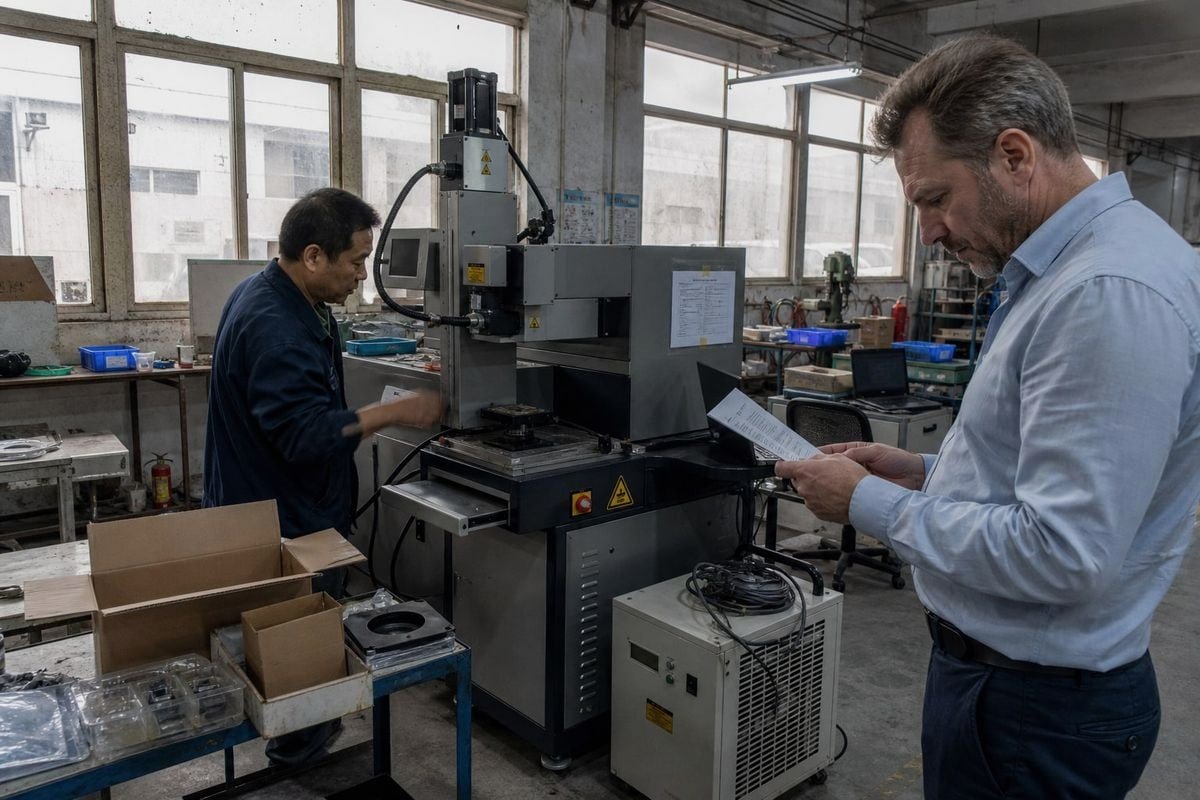
A CCD laser marking machine quote rarely tells the whole story. In our Dongguan factory, we watch buyers discover extra costs weeks after payment — and it hurts trust.
Hidden costs of a CCD laser marking machine include export clearance fees, cross-border shipping, import duties, installation and training, consumable spare parts, software licensing fees, safety equipment, fixtures, and calibration. Together these can add 15–30% beyond the quoted machine price over the first year.
Below, I will break these costs into four groups. I will show you real numbers where I can, and I will tell you which fees you can negotiate away before you sign anything.
What extra fees might I face beyond the initial machine price?
Last year, a buyer from Turkey called me, frustrated. His machine was sitting at the port, and nobody had warned him about the clearance paperwork or the terminal charges.
Beyond the machine price, expect export clearance charges, cross-border freight, fuel and peak-season surcharges, import duties, port handling fees, and last-mile delivery. For a typical CCD laser marking machine shipment, these logistics-related costs alone commonly add 8–15% to the invoice value.
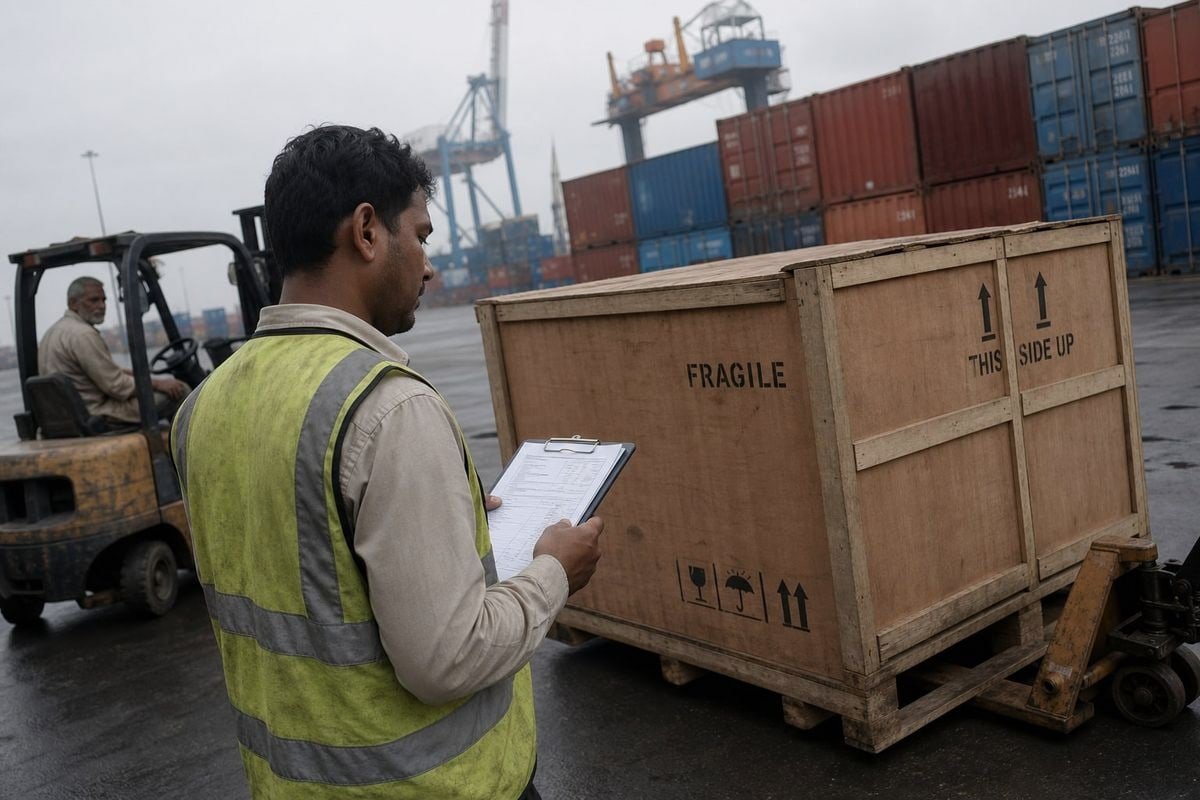
From my side of the export process, I see five cost layers that buyers often miss. I have shipped machines to the UK, Italy, the USA, the UAE, and Southeast Asia, and the pattern repeats everywhere.
The five logistics cost layers I see on every order
- Export clearance miscellaneous fees. Customs declaration, inspection, and document fees on the China side. Some suppliers absorb these; some quietly pass them to you.
- Cross-border logistics spend. Sea freight is cheaper but slow. Air freight can triple the transport bill for a heavy machine with an industrial water chiller attached.
- Freight surcharges. Fuel adjustment factors, peak-season surcharges, and currency adjustment fees. These change monthly and rarely appear in early quotes.
- Landing and destination costs. Import duties and shipping-terminal handling, customs brokerage 1 at your port, demurrage if paperwork stalls, and trucking to your factory door.
- Long-term hidden outlays. These start after delivery — I cover them in the next sections, but budget for them from day one.
A sample cost picture
| Cost Item | Who Usually Pays | Typical Range (Share of Machine Price) |
|---|---|---|
| Export clearance fees | Supplier (verify!) | 0.5–1% |
| Sea freight + insurance | Buyer | 3–6% |
| Freight surcharges | Buyer | 1–2% |
| Import duties + VAT | Buyer | 0–10% (country dependent) |
| Port handling + delivery | Buyer | 1–3% |
My advice: ask for a quote broken down by Incoterm (EXW, FOB, CIF, DDP) 2. When we quote DDP for regular customers, they know the total landed cost before wiring a single dollar. That transparency alone prevents most of the port-side surprises I described above.
How much should I budget for maintenance and replacement parts over time?
There is a trade-off I discuss with almost every purchasing manager: a cheaper machine saves money on day one but usually costs more by year two through breakdowns and downtime.
Budget roughly 3–5% of the machine price per year for maintenance. This covers protective lenses, filters for the fume extraction system, chiller fluid, cleaning supplies, and periodic recalibration. Add a reserve for galvanometer scanner maintenance and eventual laser source replacement after its rated lifespan.
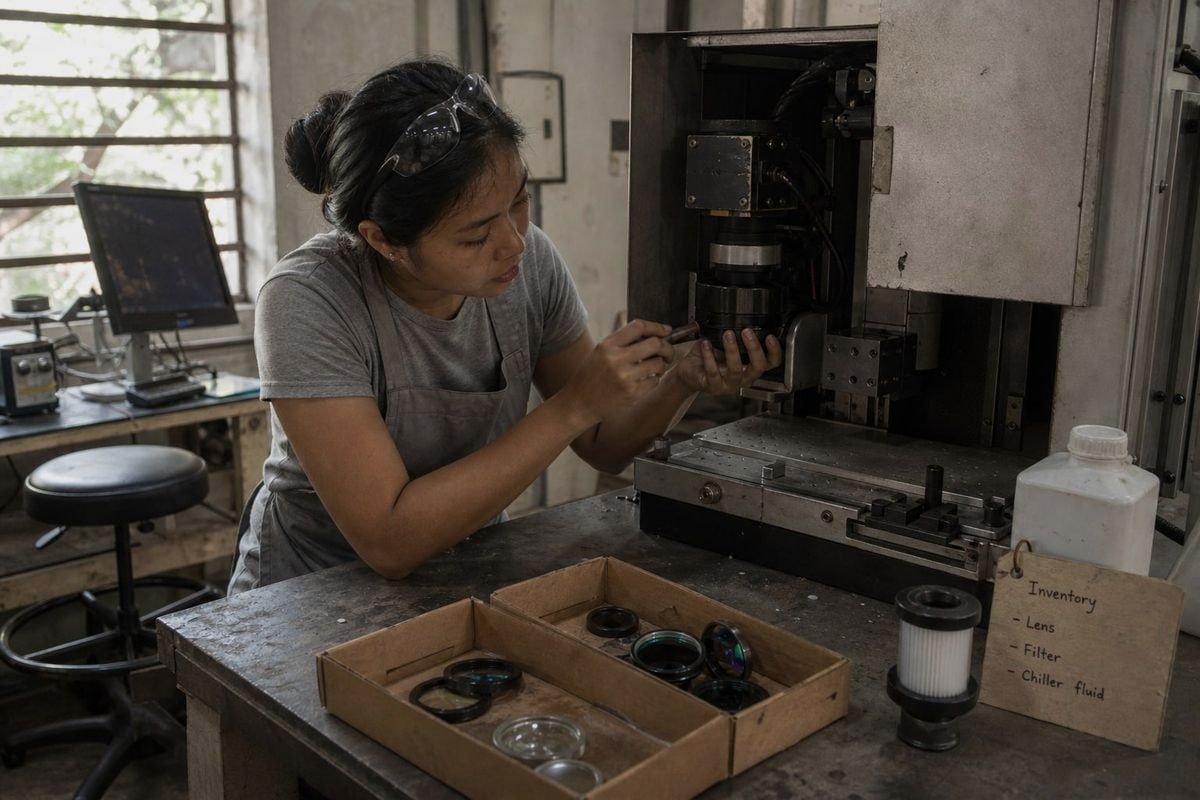
Laser marking is often sold as a "no-consumables" process. That claim is mostly true compared to inkjet printing, but it is not the full picture. In our after-sales records, the same handful of items come up again and again.
What actually wears out
Optical consumables. Protective lenses sit closest to the marking zone and collect debris. In dusty workshops, they may need replacement every few months. Focal lenses last longer but are not eternal.
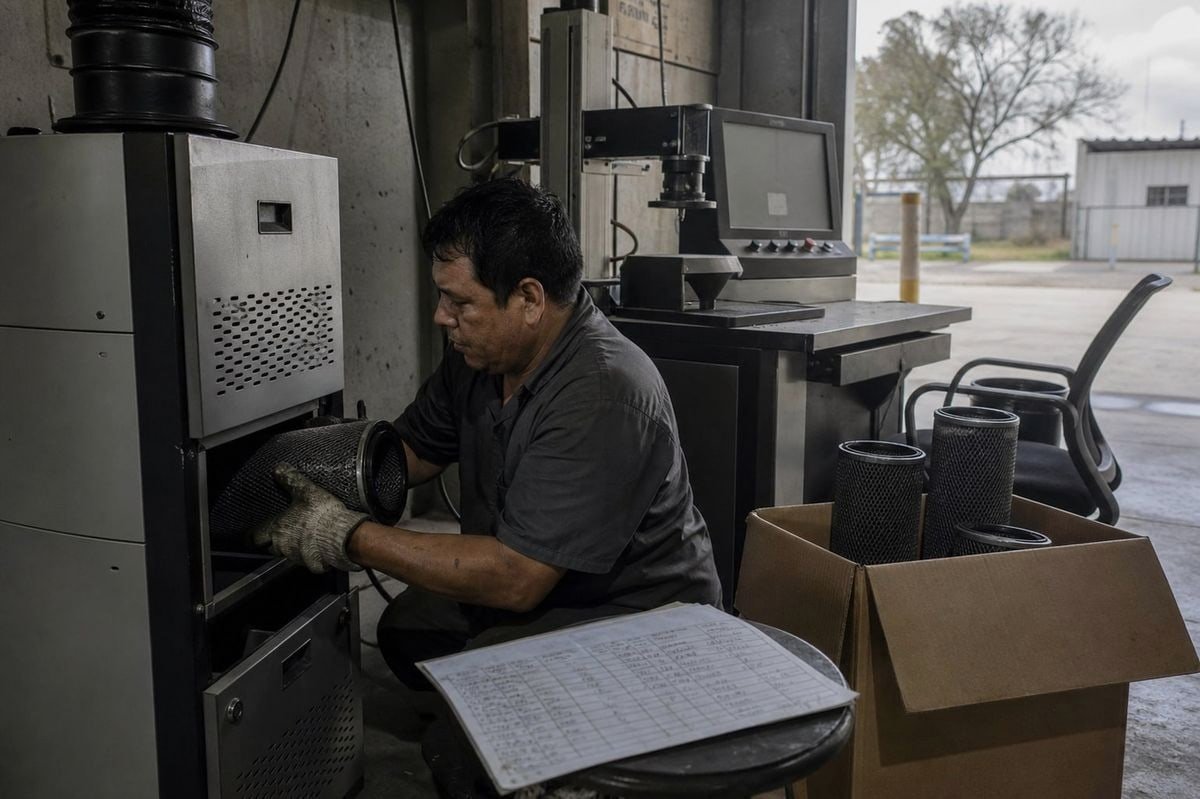
Fume extraction filters. If you mark plastics like ABS or PVC, an industrial-grade fume extraction system is essential, and its HEPA and carbon filters are a genuine recurring cost. Filter spend often surprises buyers more than lens spend.
Cooling system upkeep. Machines with an industrial water chiller need periodic fluid changes and pump checks. Skipping this shortens laser source lifespan — the most expensive component in the whole system.
Vision components. The CCD camera and its lighting module can drift. Thermal changes cause vision-to-laser coordinate drift, so plan for periodic field of view calibration using glass calibration targets. These targets themselves are a small but real recurring expense.
Typical maintenance budget over five years
| Item | Replacement Cycle | Relative Cost |
|---|---|---|
| Protective lenses | 3–12 months | Low |
| Fume extraction filters | 1–6 months | Low–Medium |
| Chiller fluid + pump service | 6–12 months | Low |
| Glass calibration targets | 1–2 years | Low |
| Galvanometer scanner service | 3–5 years | Medium |
| Laser source replacement | End of rated hours | High |
One skeptical view I hear is fair: "Fiber lasers 3 are rated for 100,000 hours, so why worry?" My answer is that the rating assumes stable cooling, clean power, and clean optics. Neglect the small stuff, and the big component fails early. A modest annual maintenance budget protects your largest single investment.
Will I need to pay extra for installation, training, or technical support?
A buyer in Italy — a business owner running a mixed-product metal shop — once told me over WhatsApp that his previous supplier charged him separately for every single remote support call. He never saw that clause coming.
Yes, unless it is written into your contract. On-site technical training and installation, commissioning, electrical work, safety enclosures, and post-warranty support are frequently billed separately. Safety equipment alone can add $1,000–$3,000, and untrained operators can slow throughput for weeks after delivery.

The gap between "machine delivered" and "machine producing" is where landing and setup costs hide. Here is how I break it down for our customers before they order.
Installation and commissioning
Your shop may need electrical upgrades, compressed air lines, or a dedicated space for the chiller and fume extraction system. If the machine joins an automated production line, integration work — sensors, conveyors, PLC handshakes — is a separate engineering job. Our solution design engineers handle this scoping before shipment, but many suppliers quote the bare machine only and let you discover integration costs later.
Training and the learning curve
A CCD system adds a visual positioning system to the workflow. Operators must learn template creation, lighting adjustment, and field of view calibration — not just "press start." Cost guides consistently list training as a hidden expense, and I agree: the real cost is not the training fee itself, but the weeks of reduced throughput while your team climbs the curve. Even ambient lighting matters; unstable workshop lighting creates optical noise that causes vision failures, and stabilizing it may mean buying shrouds or dedicated LED lighting.
Safety compliance
Depending on your protective housing class, you may need interlocked enclosures, certified wavelength-specific safety glasses 4, signage, and PPE. One industry breakdown puts safety equipment at roughly $1,000–$3,000 for some shop setups. Regulators in the USA and EU take laser safety seriously, so treat this as mandatory, not optional.
Ongoing support
Ask three questions before signing: Is remote support free during the warranty? What does a post-warranty support contract cost? How fast can spare parts ship to your country? Cheaper suppliers often save you money upfront and cost you far more in downtime when support is slow.
Could customization or software upgrades add unexpected costs to my purchase?
When we scope a custom project, the first thing I map out is not the laser — it is the fixtures, the software licenses, and the data pipeline. Those three items decide the real budget.
Yes. The CCD vision premium (around $3,500 in one vendor example), custom fixtures and jigs, software licensing fees, telecentric lens upgrades, and traceability data storage can all add unexpected costs. Proprietary software ecosystems can also lock you into paid updates and vendor-specific accessories.
CCD looks like an automation upgrade, but the real cost is in making it reliable. That sentence sums up ten years of my customer conversations, so let me unpack it.
The vision premium and what surrounds it
The visual positioning system itself is an added-cost configuration — camera, lighting, image-processing software, and mounting hardware. One vendor comparison places the vision add-on around $3,500. But the camera is only the start. If you need edge-to-edge accuracy across a large marking field, a telecentric lens upgrade may be required to eliminate parallax distortion at the field edges. That is a genuine cost few first-time buyers anticipate.
Fixtures still matter
A common misconception is that CCD removes the need for fixtures. It does not. Vision reduces manual alignment, but parts still need repeatable placement and handling. For mixed-SKU shops, every new product may need a new jig plus a new vision template, and frequent changeovers become a labor cost of their own. To be fair to the skeptics: if your parts are simple, repeatable, and easy to fixture, a standard marker with a good jig may beat CCD on total cost. CCD earns its premium when part placement varies, batches change often, or mechanical accuracy is hard to achieve.
Software, licenses, and data
| Cost Item | One-Time or Recurring | Watch-Out |
|---|---|---|
| Vision software license | Often one-time | Verify updates are included |
| Software licensing fees for advanced modules | Recurring | Traceability and automation features may be paid tiers |
| Proprietary accessory lock-in | Recurring | Vendor-only lenses, lights, and boards |
| CCD verification image storage | Recurring | High-resolution archives grow fast for traceability |
| Custom automation integration | One-time | Scope it in writing before ordering |
If you archive high-resolution CCD verification images for traceability — common in medical device and automotive work — budget for data management and storage too. My rule for buyers: get every software module, license term, and upgrade fee listed in the contract. What is written costs nothing to confirm; what is assumed costs money later.
Conclusion
The sticker price is the start, not the total. Budget for logistics, duties, training, consumables, and software — and demand a landed-cost breakdown before you buy.
Footnotes
1. Authoritative Wikipedia entry defining customs brokerage and its role in international trade compliance. ↩︎
2. Official guide to international commercial terms used in global trade and shipping contracts. ↩︎
3. Comprehensive technical overview of fiber laser technology and its industrial marking applications. ↩︎
4. Official regulatory guidance on safety equipment and standards for radiation-emitting laser products. ↩︎