
Buyers often tell me they wired deposits to a [CCD laser marking machine supplier](https://lansulaser.com/how-filter-out-reliable-ccd-laser-marking-machine-suppliers-china/) who then vanished. From our Dongguan factory floor, I know exactly what genuine proof looks like.
Verify a CCD laser marking machine supplier online by searching its 18-digit Unified Social Credit Code on China’s GSXT registry, confirming its business scope includes laser equipment manufacturing, validating ISO 9001 and CE certificates with the issuing bodies, and cross-checking real export records on customs data platforms.
That is the short answer. The full process is a chain of proof, not one document. Below, I will walk you through each link in that chain, step by step.
What Documents Should I Ask My CCD Laser Marking Machine Supplier to Provide?
A purchasing manager from Italy once asked me for our complete document pack before his first video call. I sent everything within an hour. His request was smart, and I respected it.
Request the business license showing the 18-digit Unified Social Credit Code, ISO 9001 certificate, CE compliance certificate for your market, import-export registration, patent or software copyright certificates, a recent third-party inspection report, and factory audit evidence — all displaying the exact same legal company name.

In my own sourcing checks on component vendors, I follow five verification points. First, check the business license: the company must be in active status (存续) and the business scope must match laser equipment production. Second, look for High and New Technology Enterprise (HNTE) status and production-related qualifications. Third, verify the authenticity of ISO 9001 certification 1 and export certificates. Fourth, check patents and the social insurance headcount, because real factories pay social insurance for real workers. Fifth, confirm the company holds import-export rights, which proves genuine export compliance capability.
The Core Legal Documents
The business license is the foundation. Without it, nothing else matters. The import-export registration 2 matters just as much for overseas buyers. A trading company with no export rights will quietly route your order through a third party, and you lose traceability.
Quality and Technical Qualifications
ISO 9001 certificates are typically valid for three years with annual surveillance audits. So an old screenshot proves nothing about today. Patents and software copyrights for vision-guided marking show real R&D depth behind the visual inspection system, not just assembly work.
| Document | What It Proves | What to Check |
|---|---|---|
| Business license | Legal existence | Active status, business scope, USCC number |
| ISO 9001 certificate | Quality management | Certificate number, validity dates, scope |
| CE compliance certificate | EU market access | Issuing body, exact model covered |
| Import-export registration | Export compliance ability | Company name match |
| Patents / software copyrights | R&D capability | Listed on CNIPA database |
| Third-party inspection report | Production reality | Report date, inspector identity |
How Can I Confirm a Laser Marking Machine Manufacturer's Business License Is Genuine?
I learned the value of business license verification early. Years ago, a supplier we almost partnered with turned out to be deregistered. One free database search saved us months of trouble.
Search the supplier's 18-digit Unified Social Credit Code on China's National Enterprise Credit Information Publicity System (GSXT). Confirm the status shows active, the business scope explicitly covers laser equipment manufacturing, and the registered capital, address, and legal representative match every document the supplier sent you.

The GSXT, also called the NECIPS database, is free and public. You do not need a Chinese phone number. You only need the company's Chinese legal name or its Unified Social Credit Code. A NECIPS database search takes about ten minutes and settles the biggest question first: does this company legally exist right now?
What Each Field Tells You
| License Field | Why It Matters |
|---|---|
| Status (存续) | Active status; deregistered or revoked companies are dead ends |
| Business scope (经营范围) | Must include manufacturing of laser machinery, not just sales |
| Registered capital | Registered capital verification signals scale; CCD laser production needs real investment |
| Establishment date | Longevity matters in high-precision equipment |
| Legal representative | Should match the name on contracts |
| Social insurance headcount | Real employee numbers expose shell companies |
The business scope line is where a manufacturer vs trading company difference shows up clearly. If the scope only lists wholesale or sales, you are dealing with a middleman, no matter what the website claims. Our own license lists R&D and production, and I encourage buyers to check it themselves.
One more critical step. Match the legal name on the license against the beneficiary name on the proforma invoice 3 and bank account. Payment redirection to an unrelated personal account is one of the most common fraud patterns I hear about from buyers.
Which Online Platforms Help Me Check a Chinese Supplier's Certifications and Export History?
When we ship machines to Germany, Italy, or the USA, buyers often cross-check us on three platforms at once. I actually welcome it, because the data confirms what we claim.
Use GSXT for legal registration, CNIPA for patents and software copyrights, the SGS, TÜV Rheinland, or Bureau Veritas portals for certificate validation, ImportYeti or Panjiva for real export history, and Alibaba or Global Sources audit reports for on-site factory evidence.
Each platform answers a different question. Use them together, not separately.
| Platform | What It Verifies | Cost |
|---|---|---|
| GSXT (NECIPS) | Legal registration, status, scope | Free |
| CNIPA database | Patents and software copyrights (软件著作权) for vision systems | Free |
| SGS / TÜV Rheinland / Bureau Veritas portals | ISO 9001 and CE certificate authenticity by number | Free |
| ImportYeti / Panjiva | Actual export shipment records 4 | Free / paid tiers |
| Alibaba / Global Sources audit reports | On-site photos of production lines and testing equipment | Free to download |
| Provincial government portals | HNTE high-tech enterprise status | Free |
Certificate validation deserves special care. Enter the certificate number directly into the issuing body's portal. Never trust the image alone. Because ISO certificates expire and require annual surveillance, a genuine supplier can always show a current record.
Customs data platforms function as an indirect export license check. If a supplier claims ten years of exports but shows no shipment records of laser equipment, ask why. Some buyers tell me marketplace verification badges alone are enough. I disagree. Those badges narrow the field, but platform verification is a starting point, not proof of current compliance. Cross-check the audit report details against the government registry every time.
What Red Flags Should I Watch For When Verifying a Laser Marking Machine Supplier's Credentials?
Every trade-off in sourcing comes down to price versus proof. Our engineers sometimes inspect competitor machines that failed abroad, and the warning signs were almost always visible online beforehand.
Watch for missing registration numbers, company names that differ between license and invoice, expired or screenshot-only certificates, a business scope limited to sales, zero social insurance employees, refusal of a live video audit, and precision claims like ±0.01 mm offered without any model-specific test report.

Here are the red flags I would treat as deal-breakers, in rough order of severity.
- No Unified Social Credit Code anywhere. A legitimate Chinese company always has one and will share it.
- Name mismatches. The license, certificate holder, and bank beneficiary must be one identical legal entity.
- Certificates without numbers or issuing bodies. Vague claims like "ISO certified" or "CE approved" with no verifiable number are the classic failure signal.
- Sales-only business scope. This exposes a trading company posing as a factory.
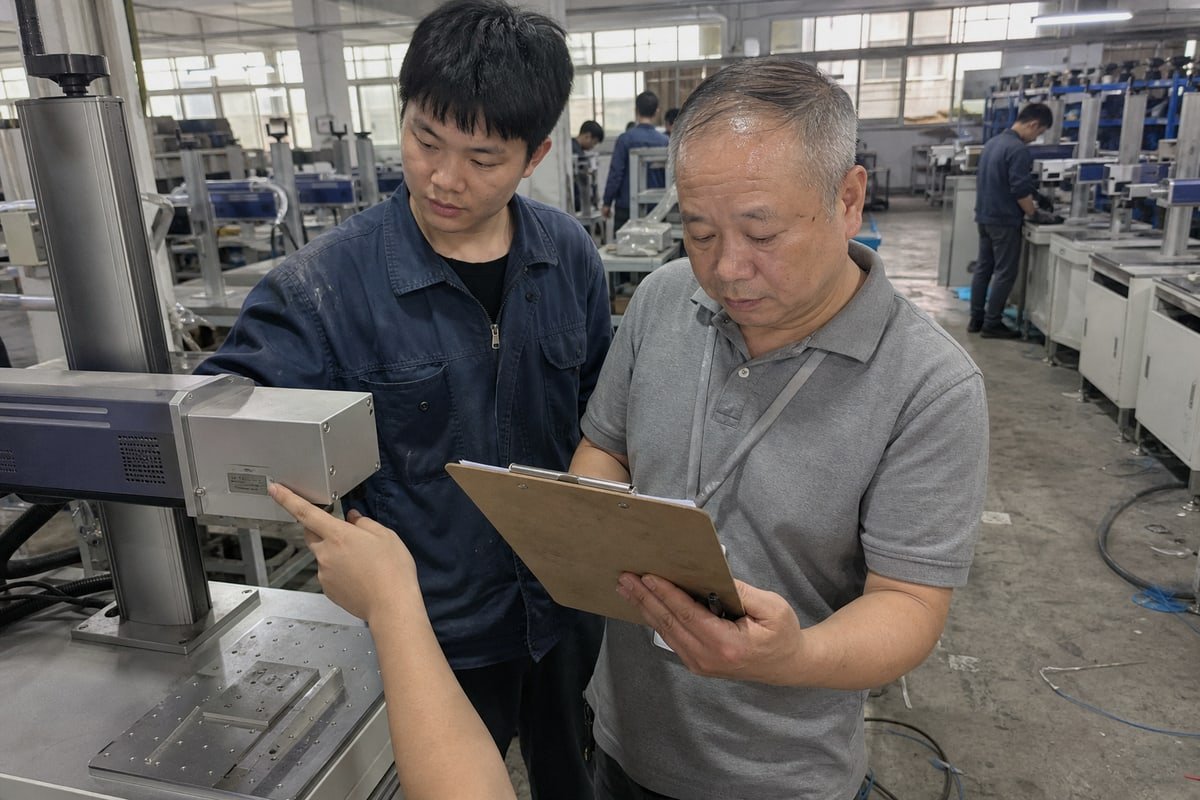
- Refusal of a live, unannounced video walkthrough. A genuine plant welcomes it. This simple test defeats shadow factories and rented showrooms, and it substitutes well when a full on-site factory audit is not possible.
- Unsubstantiated performance claims. Numbers like ±0.01 mm marking precision, defect rates below 0.5% per batch, or uptime above 99% are meaningful only with model-specific test reports behind them.
CCD-Specific Scrutiny
A CCD system is a vision-guided alignment module, and its integration quality varies widely even when the laser source looks identical. Ask whether the camera, control software, and laser module are all covered in the documentation, not just the base machine. For US-bound orders, confirm the supplier understands FDA laser safety standards, since laser products face separate radiation compliance rules there.
Conclusion
Fake suppliers cost buyers deposits and deadlines. Real verification is a chain of proof: identity, legality, compliance, capability. Check every link online first — I gladly share our documents anytime.
Footnotes
1. Official source for verifying quality management standards and the authenticity of international certifications. ↩︎
2. Global trade authority providing context on international business registration and manufacturing trade requirements. ↩︎
3. Authoritative resource for understanding commercial documentation and preventing payment fraud in international trade. ↩︎
4. World Customs Organization resource for understanding international trade data and shipment verification processes. ↩︎