


Buyers ask our Dongguan team one blunt question: does this CCD laser marking machine supplier offer long-term service contracts 1, or silence after year one? That silence stops production lines.
A CCD laser marking machine supplier offers genuine long-term service contracts when it will sign a written multi-year agreement that defines service years and renewal, covers repair, technical support, and spare parts, states response times for faults and remote support, and includes breach liability clauses.
That answer sounds simple. In practice, most buyers never see the contract before they pay. So I want to walk you through the exact checks I use when a purchasing manager in Italy, the USA, or Vietnam asks me to prove that our after-sales support will still exist in year five. The checks work on any supplier, including us.
What Should I Look for in a Supplier's Long-Term Service Agreement Terms?
Every quote our Dongguan team prepares forces one trade-off: a longer headline warranty that reads well, or a shorter one wrapped in a precise, measurable service agreement.
Look for a defined contract term with renewal rules, a component-by-component scope covering the CCD camera, laser source, and software, measurable response and resolution times, a preventive maintenance schedule, spare parts commitments, transparent exclusions, and written penalties when service targets are missed.

The first mistake I see is simple. Buyers treat five different words as one thing. They are not one thing. A warranty is not a Service Level Agreement. Lifetime support is not a maintenance contract. Here is how I separate them for customers.
Five Terms That Are Not the Same
| Term | What it usually covers | What it usually lacks |
|---|---|---|
| Warranty | Manufacturing defects for a fixed period | Labor, travel, wear parts, response times |
| Technical support 2 | Email, phone, messaging, remote troubleshooting | Guaranteed resolution, on-site work |
| Maintenance contract | Scheduled inspection, cleaning, calibration, preventive replacement | Measurable uptime targets |
| Service Level Agreement | Response, resolution, escalation, uptime, reporting | Nothing, if written properly |
| Lifetime support | An open promise to help | Scope, pricing, deadlines, remedies |
The Five Points I Ask Every Buyer to Confirm in Writing
I give new customers a short list. It is the same list I would use if I were buying a machine myself.
- Confirm contract willingness. Ask directly whether the supplier supports signing a long-term service contract. A yes or no tells you a lot before any price talk begins.
- Clarify the service term. Confirm how many years of after-sales support are included and how renewal works. Is renewal automatic? What notice period applies? Can prices rise each year?
- Agree on service content. The contract must list repair, technical support, and parts supply as separate items. For a CCD machine, it must also name the camera, lens, lighting, and vision software.
- Confirm response time. Write down the time to acknowledge a fault, the time to a remote diagnosis, and the time to a proposed fix. "Fast" is not a number.
- Verify breach liability. Service promises and breach clauses go into the signed contract. If they live only in a brochure, they are marketing.
Watch the Start Date
Some published warranty terms begin when the equipment leaves the factory, not when you accept it. Shipping, customs, and site preparation can quietly eat two or three months of coverage. Our contracts tie the clock to acceptance testing, and I advise buyers to insist on the same wording from anyone.
One public policy I often show buyers as an example offers a two-year warranty on the fiber laser source 3, one year on other accessories, lifetime remote support, and fee-based on-site maintenance. That is a legitimate structure. But notice what it is: a warranty plus a help line. It is not a long-term service contract unless scope, timing, and remedies are added.
How Can I Verify a Supplier's Track Record for After-Sales Support?
Jerry, a business owner in Italy, once asked me on WhatsApp for proof, not promises. So I sent him anonymized service reports and a video of our Dongguan parts shelf.
Verify after-sales track record by requesting a sample service contract before ordering, speaking with two or three current users of comparable CCD systems, reviewing anonymized service reports, testing the support ticketing system, and checking that technicians are trained on the actual camera, scanner, and software.
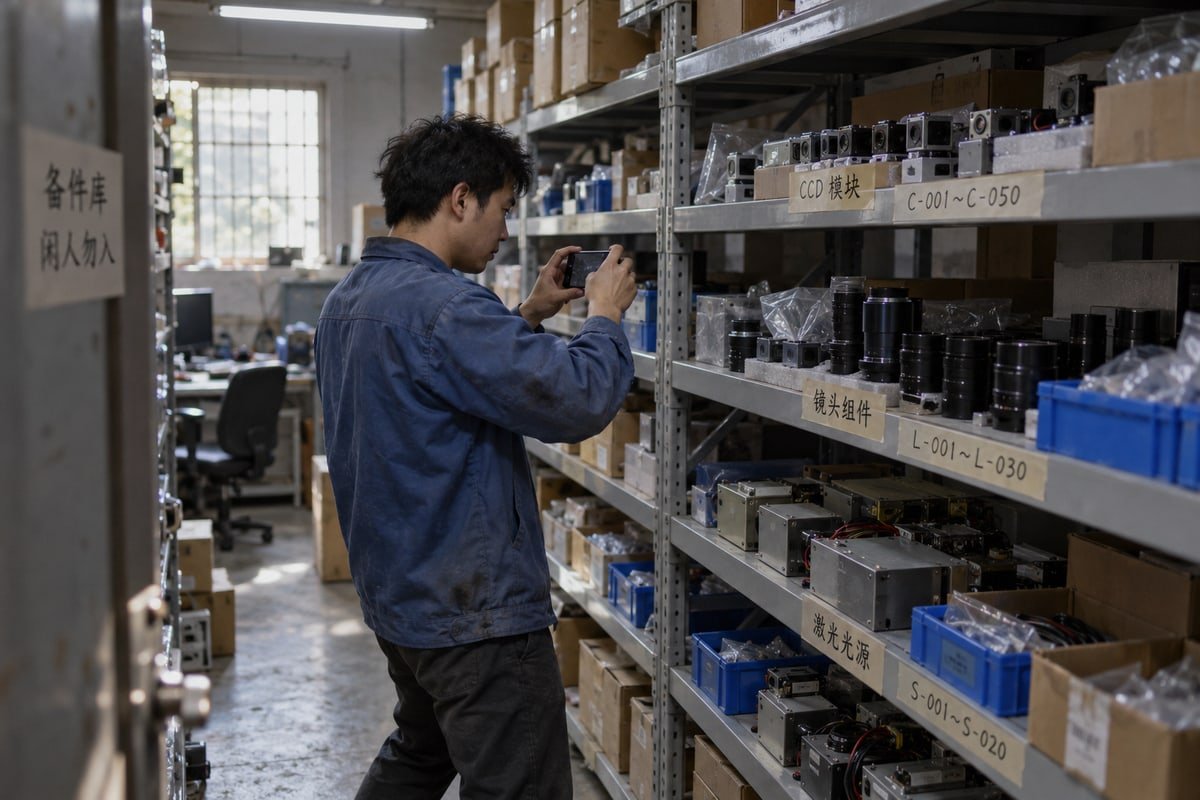
Jerry's request changed how I present our after-sales support. He did not want adjectives. He wanted evidence he could check himself. Here is the verification process I now recommend to every purchasing manager, step by step.
A Six-Step Verification Process
- Request the sample contract first. Ask for it before you issue a purchase order. If the supplier cannot produce one within a few days, it probably does not have a service program. It has a sales team.
- Ask for a service map. The map should show where engineers sit and where parts are stored. Our map shows Dongguan as the parts and engineering hub, plus the markets we actively serve, such as Germany, Turkey, Australia, and Saudi Arabia.
- Speak with current users. Ask for two or three customers running a visual positioning system on similar parts. Ask them one question: what happened the last time the machine stopped?
- Read anonymized service reports. A real report lists the job number, the fault, the remote diagnosis, the parts used, the test marking result, and the calibration status. A fake program has no reports to show.
- Test the ticketing system. Open a support ticket before you buy. Note who answers. If the salesperson answers every technical question, there is no dedicated after-sales team behind the website.
- Check technician training. Ask whether field technicians are trained on the specific fiber laser source, galvo scanner, camera, and software in your machine. A generalist cannot recalibrate fiducial recognition.
What a Real Incident Workflow Looks Like
Our engineers can describe the whole chain from memory. Fault report. Remote diagnosis with photos, videos, and a remote session. Parts reservation. Shipment. On-site intervention if needed. Test markings on your reference samples. Calibration validation of the CCD system. Final service report. Ask any supplier to describe this sequence. Hesitation is a signal.
Red Flags I Have Learned to Spot
A supplier that only talks about laser-source replacement does not understand a vision-guided machine. A supplier that cannot say who performs on-site work in your country will be improvising when something breaks. A supplier that cannot explain holiday coverage, especially around Chinese New Year, has not thought about your production calendar.
Which Warranty and Maintenance Options Indicate Real Long-Term Commitment?
One lesson our 20 solution design engineers learned the hard way: a buyer who only hears about laser-source replacement will discover the CCD camera and lens were never covered.
Real commitment shows in warranty extensions covering the fiber laser source and CCD camera sensor for three to five extra years, scheduled preventive maintenance with optical cleaning and galvo calibration, written wear-part policies, regional spare parts stock, software lifecycle support, and fixed-price modular upgrade clauses.
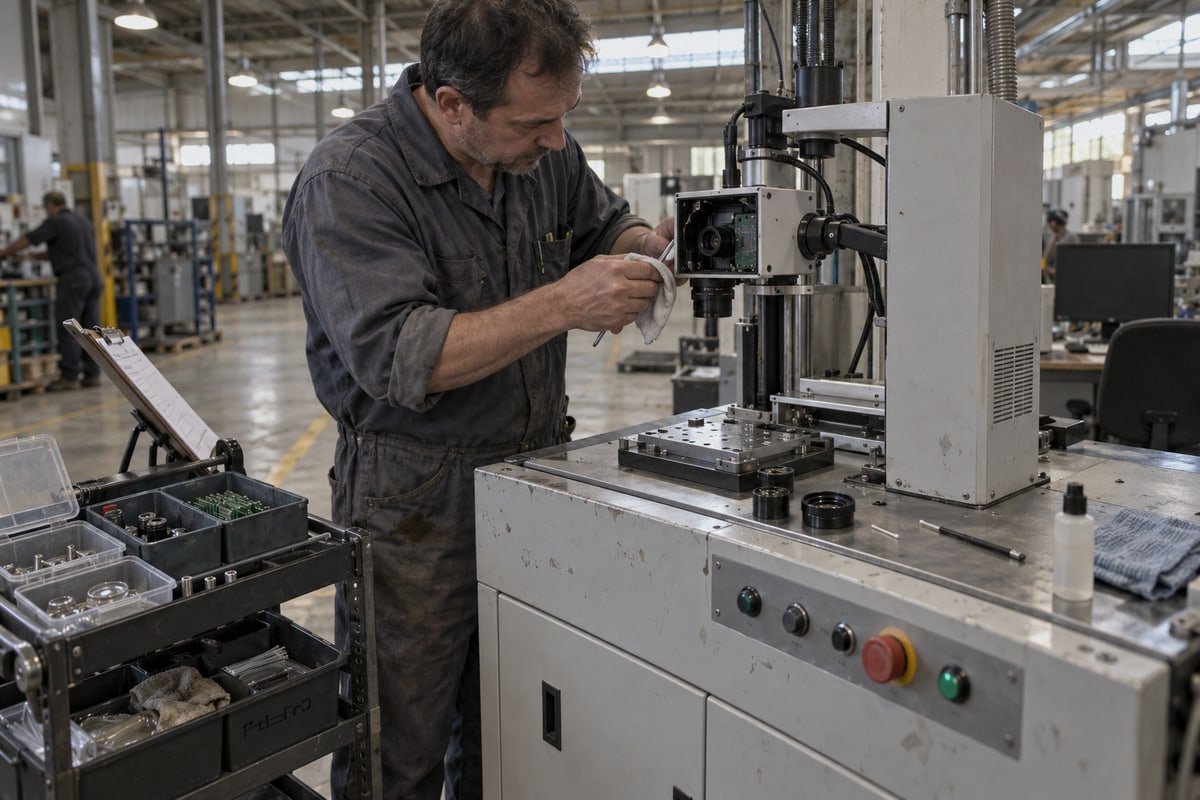
A long warranty number on a quote is not the same as long-term commitment. I have seen one-year whole-machine warranties paired with excellent maintenance programs. I have also seen three-year warranties that excluded every part likely to fail. Scope beats length.
Service Tiers Should Be Compared Line by Line
A serious supplier offers tiers and explains them. A weak supplier offers one label, usually "premium support," and hopes you do not ask. This is how I lay out tiers for buyers.
| Tier | Includes | Best for |
|---|---|---|
| Remote only | Remote troubleshooting, software help | Low-utilization workshops with local technicians |
| Preventive maintenance | Scheduled visits, optics cleaning, calibration, reports | Steady single-shift production |
| Parts replacement | Stocked critical parts, dispatch targets | Sites far from any service partner |
| Priority response | Shorter acknowledgment and diagnosis targets | Multi-batch production with tight schedules |
| On-site repair | Labor and travel included | Automated lines with no in-house laser skills |
| Full uptime coverage | Resolution targets, loaner source, service credits | Automotive, medical, electronics traceability |
Preventive Maintenance for a CCD Machine Is Not Just Cleaning Optics
A proper preventive maintenance visit 4 on one of our machines covers the laser side and the vision side. Laser side: optics inspection, focus verification, power stability check, galvo positioning check, cooling and ventilation, safety interlocks. Vision side: CCD image calibration, lighting and exposure verification, fiducial-recognition accuracy tests, fixture and rotary-axis inspection, and backups of calibration files and marking recipes. The visit ends with test markings on agreed reference samples and a written report. If a supplier's maintenance list stops at the laser, it does not protect your visual positioning system.
Exclusions Decide the Real Price
| Common exclusion | Why it matters for a CCD machine |
|---|---|
| Travel and accommodation | Often the largest cost of any on-site visit |
| Consumables and wear parts | F-theta lenses and protective windows fail with use, not defects |
| Post-warranty parts and shipping | Several public policies make these customer costs |
| Unauthorized software changes | A Windows update can break camera communication |
| Recalibration after relocation | Moving the machine shifts camera-to-galvo alignment |
| Third-party components | The camera and PC often come from other vendors |
Is a Long-Term Contract Worth the Money?
Buyers push back, and they should. Some tell me a contract costs more than occasional repairs. Others fear bundled visits they do not need, or a lock-in with a supplier that fades. These objections are fair. My answer is a three-year total cost comparison: contract price, expected repairs without a contract, downtime cost per hour, emergency freight, and the value of preventive work. For a low-utilization workshop with a good local technician, pay-as-needed can win. For a high-volume automated line, equipment downtime reduction usually pays for the contract on its own. Then I add two protections against lock-in: a cancellation clause and a fixed-price modular upgrade clause for the laser source or camera resolution, so obsolescence does not strand the buyer.
Newer options are worth asking about too. Firmware and library lifecycle support should give you new vision templates and recognition updates. Predictive telemetry should alert you to degrading beam quality or camera focus before scrap appears. These only mean something if the contract names thresholds, alerts, and actions.
How Do I Confirm a Supplier Can Provide Ongoing Technical Support Across Countries?
During a night shift in Dongguan, our engineer walked a Malaysian operator through a camera recalibration over a remote session. The line restarted before the local morning shift.
Confirm cross-border support by asking for a service map of engineers and parts locations, named regional partners in your country, stated time-zone and holiday coverage, remote troubleshooting requirements, stocked-part dispatch times, who pays travel and customs, and contract transferability if the machine relocates.

That night-shift call worked because the fault was a calibration drift, not a hardware failure. Remote support has limits, and honest suppliers say so. When a buyer in Sweden or the UAE asks me what "global support" means, I break it into layers.
Four Support Layers and What Each One Actually Solves
| Support layer | Solves | Cannot solve |
|---|---|---|
| Remote troubleshooting | Software faults, parameter errors, camera recalibration guidance | Failed power supply, damaged scanner, lens replacement |
| Regional spare parts stock | Fast replacement of windows, filters, fans, cables, power supplies | Faults that need an engineer's hands |
| Local authorized partner | On-site repair, routine preventive maintenance | Deep laser-source or vision software issues without factory backup |
| Factory engineer dispatch | Any fault, including full recalibration and acceptance retest | Same-day response in a distant country |
Spare Parts Availability Across Borders
Ask two numbers. What is the dispatch time for stocked parts, and what is the lead time for non-stocked parts? One published support policy states one to two working days for stocked components and about a week for items that are not stocked. Those are reasonable targets to write into your own agreement. Then ask the harder question: stocked where? "Global support" can mean a regional consignment shelf of protective glass, scanner windows, power supplies, fans, and filters near your plant. It can also mean one warehouse in China. Both can be honest. Only one gives you fast spare parts availability. For critical lines, we recommend the buyer holds a small recommended spare-parts kit on site, and the contract states whether a used part is covered for the rest of the term.
Remote Access Has a Cost Too
Remote troubleshooting is now standard. Suppliers ask for serial numbers, fault videos, and remote PC access before shipping anything. This cuts unnecessary visits. It also raises questions. Does remote support require proprietary software? Does it need unrestricted network access? Who is responsible when a remote diagnosis is wrong and production stays down? Write the answers down. Also confirm that on-site technical training for your operators is part of commissioning, because a trained operator turns many hardware calls into ten-minute remote fixes.
Questions to Send Any Supplier Before You Order
- What exactly is covered after the initial warranty ends?
- Does coverage include the CCD camera, lens, lighting, and vision software?
- Is on-site labor included, and who pays travel, accommodation, customs, and shipping 5?
- What are the guaranteed response and resolution times, in hours or days?
- Is there an uptime commitment or service credit?
- What happens if the machine cannot be repaired within the target period?
- Is loaner equipment or a substitute laser source available?
- Where are critical spare parts stored for my country?
- What is the longest lead time for a non-stocked part?
- Who repairs the laser source, the source maker or the machine supplier?
- Are software updates and license renewals included?
- Who owns calibration files, marking recipes, and customer data?
- How often are preventive-maintenance visits performed?
- Will the supplier recalibrate the CCD after every repair?
- Which wear parts are excluded, and what actions void coverage?
- How is operator error defined?
- What are renewal prices and cancellation conditions?
- Can support continue if the original technician leaves?
- Is the contract transferable if the machine is sold or moved?
- Who answers during Chinese New Year and other factory shutdowns?
Conclusion
Choose the CCD laser marking machine supplier with measurable written commitments, not the longest advertised warranty. Our Dongguan team signs those terms because production lines cannot run on promises.
Footnotes
1. Explains the formal structure of service commitments and performance benchmarks in industrial agreements. ↩︎
2. International standard for quality management systems, ensuring consistent service and customer support quality. ↩︎
3. Authoritative Wikipedia entry providing a detailed technical overview of fiber laser technology. ↩︎
4. Describes the maintenance strategy used to extend equipment life and prevent unexpected production downtime. ↩︎
5. Official resource for international trade regulations, customs procedures, and shipping requirements for machinery. ↩︎