

An on-site [factory inspection](https://lansulaser.com/what-check-during-on-site-factory-inspection-ccd-laser-marking-machines/) is the only real proof before buying a CCD laser marking machine. I have seen buyers skip it and lose months. Our Dongguan factory welcomes scrutiny.
To arrange an on-site factory inspection for a CCD laser marking machine, book the visit in advance, send a written inspection brief with your parts and acceptance criteria, verify the supplier’s legal identity, then run a sample marking test on your own products and sign a factory acceptance report.
That is the short version. The rest of this guide walks through each step in the order you will actually face it. First comes preparation. Then the visit itself. Then supplier verification, which you should start before you even book a flight. Finally, the questions you must put to the engineers face to face.
How Do I Prepare Before Scheduling a Factory Inspection for a CCD Laser Marking Machine?
Every week we weigh the same trade-off: a short showroom tour pleases visitors, but a structured inspection protects them. Preparation decides which one you get.
Before scheduling a factory inspection for a CCD laser marking machine, confirm the date and agenda in writing, send part drawings, materials, mark specifications, and production rates, request the machine configuration in writing, define numerical pass/fail criteria, and ship real production samples for the test.
Set the inspection goals first
I always ask visiting buyers one thing before we fix a date. What must you know when you leave? Most answers fall into five buckets. Is the supplier a real manufacturer? Is the proposed machine configured correctly? Can it mark my parts consistently? Can the CCD visual positioning system handle my part variation and talk to my line? Will I get support after installation? Write these five goals down. Then build the agenda around them. Our solution design engineers, twenty of them in Dongguan, prepare differently when they receive a clear brief versus a vague "we want to see your factory."
Build the inspection brief
The brief is a single document you send at least two weeks before the visit. It gives the supplier time to prepare the right machine, not just the nearest one.
| Brief item | What to include | Why it matters |
|---|---|---|
| Parts | Drawings, photos, material grade, coating, color, surface finish | Anodized aluminum and raw stainless steel need different parameters |
| Mark content | Text, logo, barcode, QR, Data Matrix, size, location | Defines marking field, lens, and camera resolution |
| Quality limits | Contrast, depth, readability, cosmetic defects allowed | Turns "good mark" into a measurable target |
| Part variation | Tolerances, orientation, height, lot differences | This is what the CCD system must compensate for |
| Production data | Rate, hours, batch size, changeover frequency | Sets the cycle time target |
| Site utilities | Power, compressed air, extraction, network, floor space | Avoids surprises during commissioning |
| Interfaces | PLC, MES, ERP, barcode readers, robots, conveyors | Drives software compatibility and integration scope |
| Acceptance criteria | Numeric pass/fail for each item above | The basis of the FAT report |
Lock the configuration before you fly
Ask the supplier to confirm the full machine specification in writing. That means laser wavelength 1 and source type, rated power, marking field, lens, scanner, focal distance, camera resolution, lighting, controller, software version, fixture design, enclosure, and the industrial cooling system. For most of our metal and plastic applications this is a fiber laser source or a MOPA source, and the buyer should know which one before arrival. A written configuration is also the baseline for checking nameplates later.
Some buyers tell me remote video testing is cheaper, so why visit at all? I agree that video is useful. We run remote sample tests for buyers in the USA, Germany, and Australia before anyone books travel, and it screens out basic incompatibility fast. But video cannot show cable workmanship, interlock behavior, calibration records, or whether the camera module is the brand on the quotation. Use remote testing to decide whether a visit is worth it. Do not use it to replace the visit.
What Should I Check During an On-Site Inspection of a CCD Laser Marking Machine Factory?
Last quarter a visiting engineer asked to open our electrical cabinet before he looked at a single marked sample. He checked the cable labels first. He was right.
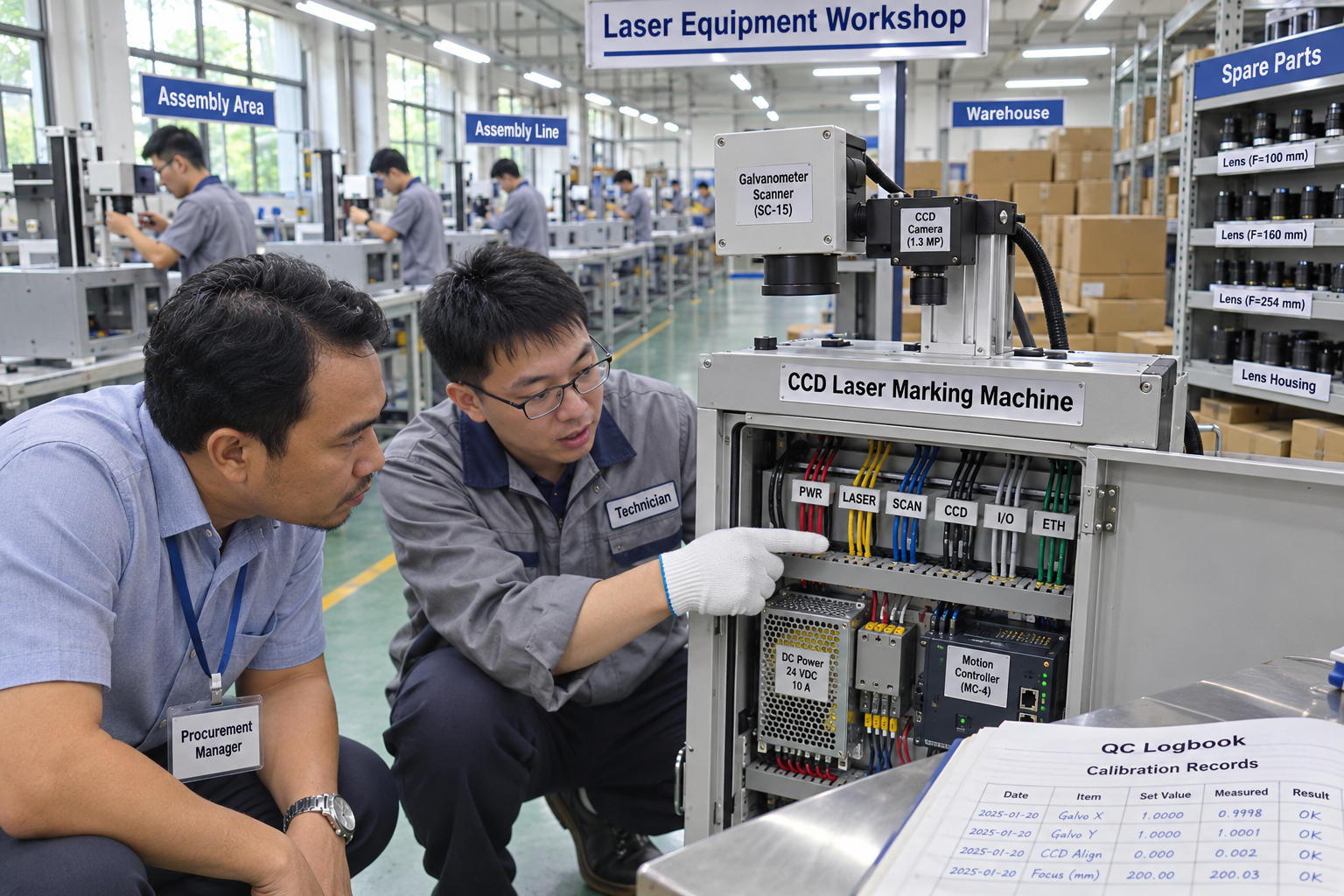
During an on-site inspection of a CCD laser marking machine factory, check the production workshop, assembly line, and warehouse, verify the laser source, CCD camera, and galvanometer brands against your contract, review QC and calibration records, test safety interlocks, and run marking trials on your own parts.
Production capacity verification
Walk the workshop, the assembly line, and the storage area in that order. You are looking for evidence of self-production and batch delivery, not a display room. Count machines in progress. Look at frames being welded or machined, not just finished units with covers on. Ask to see the spare parts 2 shelf and the incoming inspection bench. In our factory, buyers often photograph the assembly stations where galvo heads and camera modules are fitted, because that is where a trader has nothing to show.
Core components and the quality management system
This is the step my personal supplier audit checklist puts at the top. Core components decide whether the machine still works in year five.
| Component | What to verify on site | Red flag |
|---|---|---|
| Laser source | Brand, model, serial number, power test report | Nameplate differs from quotation |
| Galvo scanner | Brand, calibration record for this unit | No per-unit calibration sheet |
| CCD camera and lens | Resolution, industrial grade, thermal management | Consumer-grade sensor, no heat sinking |
| Controller and software | Version, license, API or SDK availability | Software version cannot be stated |
| Cooling | Industrial cooling system rating, airflow, filters | Undersized for continuous shifts |
Cross-reference every item with your contract to prevent silent substitution. Then ask for the internal quality control logs. You want documented laser power stability tests and galvo-head calibration records for the specific serial number you are buying, not a generic certificate. Record all serial numbers yourself.
The sample marking test
Run the trial on your own parts. Follow a fixed sequence:
- Mark best-case samples to confirm the parameter set works.
- Mark worst-case samples: the most reflective, oily, curved, or dark-coated part you have.
- Place parts at different angles and offsets to stress the Search and Find routine of the CCD visual positioning system.
- Change the ambient light. Dim it, then add a side lamp. Watch whether image thresholding stays stable.
- Repeat the same part many times and measure repeat positioning stability and marking accuracy and precision.
- Run at full production speed and record the total cycle time from part arrival to release.
Read every code with the reader and lighting you will use in production, not the supplier's inspection lamp.
Safety and documentation
Check the laser classification label, enclosure integrity, door interlocks, viewing window rating, emergency stop, key switch, and extraction. ISO 11553-1 covers laser processing machine hazards on top of IEC 60825. For the USA ask about the FDA accession number; for Europe ask how the CE Machinery Directive 3 declaration was produced. A certificate alone does not prove suitability for your workplace, so request the risk assessment and electrical drawings too.
A fair objection: the demo machine was prepared for me and run by the best technician. True. That is why you bring worst-case parts, ask your own operator to run a changeover, and demand a digital configuration freeze. The camera calibration and vision parameters from the successful test get backed up, locked, and shipped unchanged.
How Do I Verify a Supplier's Authenticity Before Visiting Their CCD Laser Marking Machine Factory?
An Italian business owner once asked me on WhatsApp: "Are you the factory, or do you just sell the factory?" I sent our address and a live video.
To verify a supplier's authenticity before visiting a CCD laser marking machine factory, check the business license and registered manufacturing address, request a live unscheduled video walk-through, confirm export records to your region, contact two reference customers, and compare the quoted brands with their engineering team's answers.
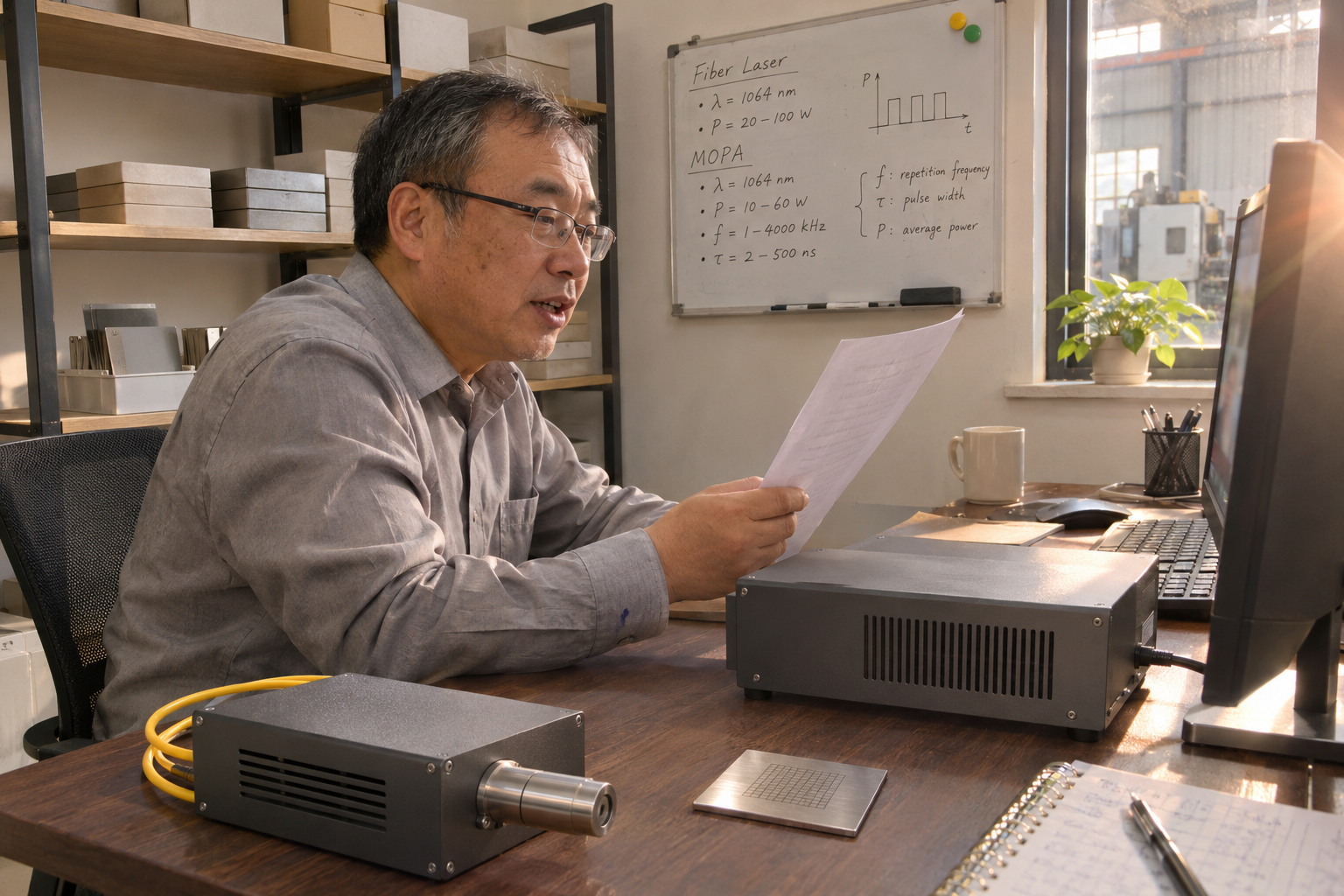
Manufacturer or trading company?
This is the second biggest pain point I hear from buyers, right after marking results. A trading company can still deliver a good machine. But it cannot give you original engineering support, and spare parts arrive through a middle layer. The difference shows up in small signals before you ever travel.
| Signal | Genuine manufacturer | Reseller or trader |
|---|---|---|
| Registered address | Matches the workshop you will visit | Office address, factory "nearby" |
| Engineering answers | Engineer joins the call and explains design choices | Sales relays questions and returns later |
| Machine photos | Same frame, same panel layout across years | Mixed designs from different sources |
| Spare parts | Own stock, lead times stated | "We will check with the factory" |
| Custom requests | Design drawing produced in-house | Only standard models offered |
| Export experience | Shipping records to your region | Vague or none |
Ask for the business license and check that the registered manufacturing address matches the place you will visit. Our company is headquartered in Dongguan with a team of 100 people, and buyers from the UK, Canada, Turkey, and Saudi Arabia have checked exactly this before coming.
Remote, on-site, or third-party?
Buyers sometimes ask whether a third-party inspection agency can replace the trip. It adds independence, and for a high-value order it is money well spent. But a general agency checks quantity, appearance, and basic power-on. It usually does not understand code grading, camera algorithms, or line integration. My advice is a layered approach. Use a live video call for first screening. Use an on-site visit for the technical FAT. Use a third-party pre-shipment inspection to confirm that the shipped unit matches the frozen configuration.
Ask about failures, not just successes
Reference customers matter. Ask for two in your industry, ideally running similar materials and CCD functions. Then ask the supplier a harder question: tell me about a failed FAT or a delayed installation. A genuine factory will explain root cause and corrective action without flinching. Delivery delays are a real risk in this business, and the way a supplier describes a past delay tells you how they will handle yours. We keep records of corrective actions in our quality management system for exactly this reason, and we show them when asked.
What Questions Should I Ask the Engineers During My CCD Laser Marking Machine Factory Visit?
The hardest lesson from years of installations across Europe and Southeast Asia is simple. Buyers who ask our engineers uncomfortable questions early have smoother commissioning later.
Ask the engineers how the CCD visual positioning system locates parts, what repeat positioning accuracy they guarantee, which laser source and galvo brands are fitted, how the software connects to MES or ERP, what the calibration and cooling routines are, and how after-sales support and spare parts are delivered.
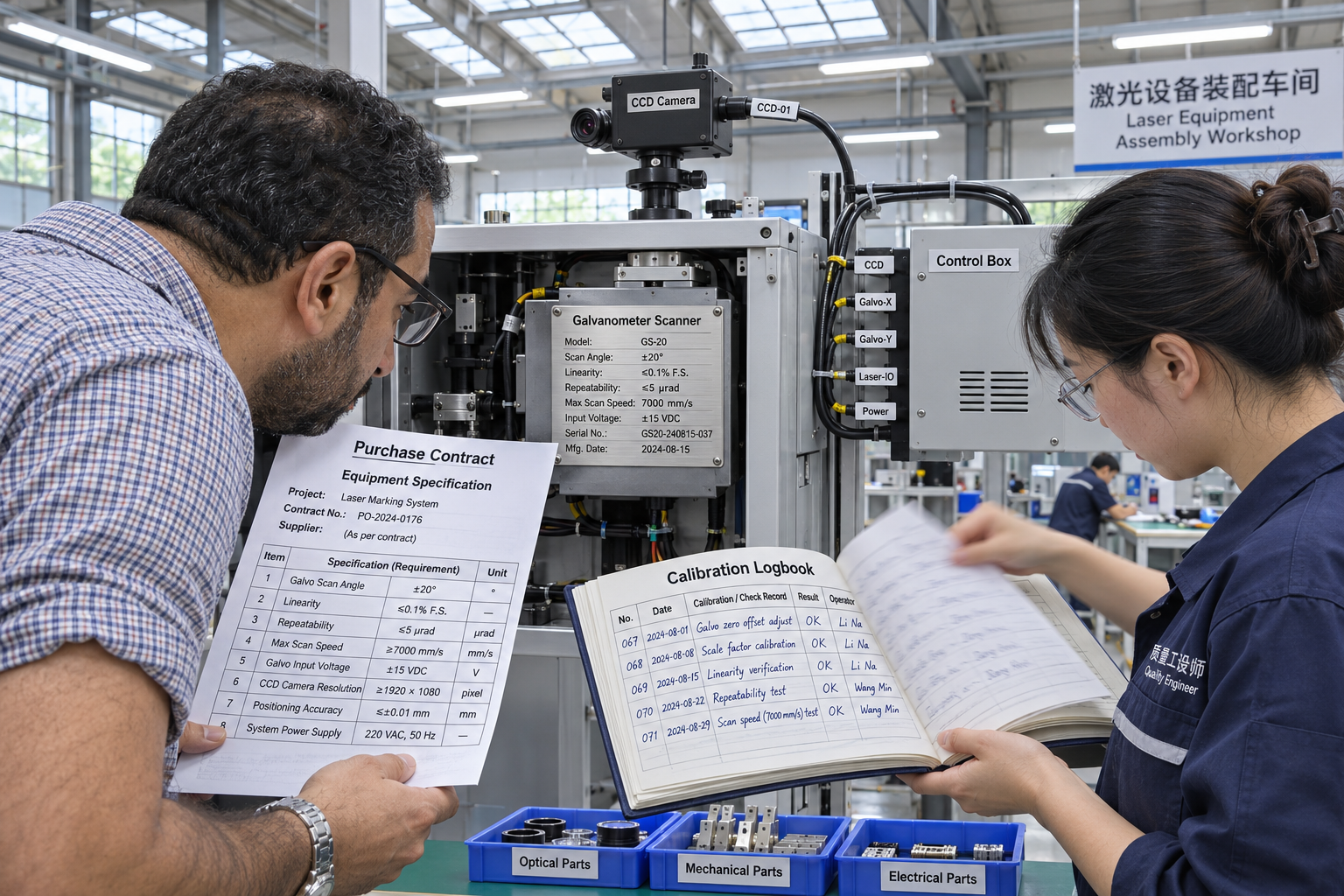
Questions grouped by topic
Vague words like "high precision" or "stable operation" should trigger a follow-up question every time. Push for numbers.
| Topic | Question to ask | Answer you want |
|---|---|---|
| Vision | What exactly does the camera do: locate, orient, verify, reject? | A defined function list, not "smart vision" |
| Vision | What is the positional error limit after CCD compensation? | A numeric tolerance in millimeters |
| Vision | How does thresholding behave if my shop lighting changes? | Lighting design and a test to prove it |
| Hardware | Which fiber laser source and galvo brand are in this unit? | Named brands matching the contract |
| Hardware | How is the CCD sensor cooled during a 16-hour shift? | Thermal management that prevents drift |
| Software | Is there an API or SDK for bi-directional MES or ERP data? | Documented interface, sample code |
| Software | Can verification be bypassed, and is a bypass logged? | Permission control plus audit log |
| Calibration | What is the machine calibration process and interval? | Written procedure with reference plate |
| Service | What is the fault response time and spare parts lead time? | Specific hours and days per component |
| Training | Who installs, who trains, and in which language? | Named scope in the contract |
Dig into the vision answers
The CCD option does not automatically give you barcode verification or full traceability. Ask the engineer to describe the data path. Job selection, serial number generation, duplicate prevention, mark verification, mismatch handling, and result logging are separate functions. Then ask them to feed wrong or duplicated data into the system in front of you. The machine should stop predictably and show a clear alarm.
A buyer once challenged me on whether they needed CCD at all. For a stable, flat, high-volume part, a fixed fixture can be more reliable and cheaper. I told him so. CCD earns its cost when parts are irregular, small, loaded in mixed batches, or fed by automation. That is where our machines go most often: auto parts, PCB boards, battery components, medical devices. If your parts never move, say so, and let the engineer argue for the simpler option.
Talk to the service team, not only sales
Sit down with the people who will answer your calls later. Ask how remote after-sales technical support works, which parts they stock locally, and how software is restored after a controller failure. Ask them to show the preventive maintenance schedule and the consumables list. Then have your own operator try a job change, a focus check, and a lens clean under their supervision. If the alarm messages confuse your operator in the showroom, they will confuse him on your line.
Conclusion
Skipping the inspection risks a machine that fails on your parts. Prepare, verify, test, and sign a FAT report. Our Dongguan team is ready whenever you want to visit.
Footnotes
1. Technical definition of the physical property determining laser-material interaction. ↩︎
2. General industrial concept of inventory maintained for machine maintenance and repair. ↩︎
3. European regulatory framework ensuring safety and health requirements for machinery. ↩︎