
Buyers ask our Dongguan team weekly how to verify a CCD laser marking machine supplier’s European customer case studies. Fake proof floods this industry, and one bad pick wastes months.
To verify a CCD laser marking machine supplier’s European customer case studies, request the proforma invoice of marked orders, on-site European marking videos, the machine-specific CE certificate, real customer cooperation photos, and EU export shipping records, then cross-check the customer’s identity through VIES and direct reference calls.
That is the short answer. But each of those five checks has a right way and a wrong way to do it. Below, I walk through the full process I recommend to every buyer who contacts us, based on what we show our own customers and what I have seen competitors fake.
How can I confirm a CCD laser marking machine supplier's European case studies are genuine and not fabricated?
Last year, a German buyer visiting our showroom showed me a competitor's Italian case study. The factory photo was a stock image, found via reverse search in thirty seconds.
Confirm genuineness by reverse-searching case study images, running Error Level Analysis for digital manipulation, validating the customer's VAT number through the EU VIES system, requesting on-site marking videos, and checking that named engineers actually worked at the customer during the stated timeline.

A polished case study page proves nothing by itself. It only becomes proof when the company, location, application, and results can be corroborated by someone other than the supplier. That is the standard I hold our own material to, and it is the standard you should apply to every CCD laser marking machine supplier you evaluate.
Start With the Images and Videos
Photos are the easiest thing to fake and the easiest thing to catch. Run every case study image through a reverse image search. Then go deeper with Error Level Analysis, a simple technique that reveals whether a marking result or a machine label was digitally pasted onto a photo. In my own experience, the strongest evidence is video, not photos. I always send prospects real on-site marking videos filmed at European customer plants, because a video showing the machine running, the operator's hands, and the surrounding production line is extremely hard to stage. Ask every supplier for the same. If they only offer studio footage from their own factory, treat the case study as unverified.
Validate the Company Itself
Next, confirm the named customer legally exists. The European Commission's VIES tool lets you check any EU company's VAT number 1 for free. Then cross-reference any named engineer or project manager on LinkedIn to confirm they worked at that firm during the stated project timeline.
| Weak Evidence | Strong Evidence |
|---|---|
| "A leading European manufacturer" with no name | Named company, plant location, and division |
| Stock factory imagery | Real cooperation photos with customer staff and machine serial visible |
| "Zero errors, works on all materials" | Measured results: accuracy, cycle time, defect reduction |
| No dates or timeline | Commissioning date and current machine generation stated |
| Reused wording across multiple "customers" | Unique technical details per project, including PLC brand 2 and software version |
What documents or contacts should I request to verify a supplier's past European installations?
An Italian buyer once messaged us on WhatsApp asking for proof before wiring his deposit. We sent five documents within an hour; he said most suppliers sent none.
Request five items: the proforma invoice of past marked orders, the EU Declaration of Conformity with matching model and serial number, EU export shipping records or bills of lading, commissioning and OQ/PQ validation data, and direct contact permission for at least one European reference.
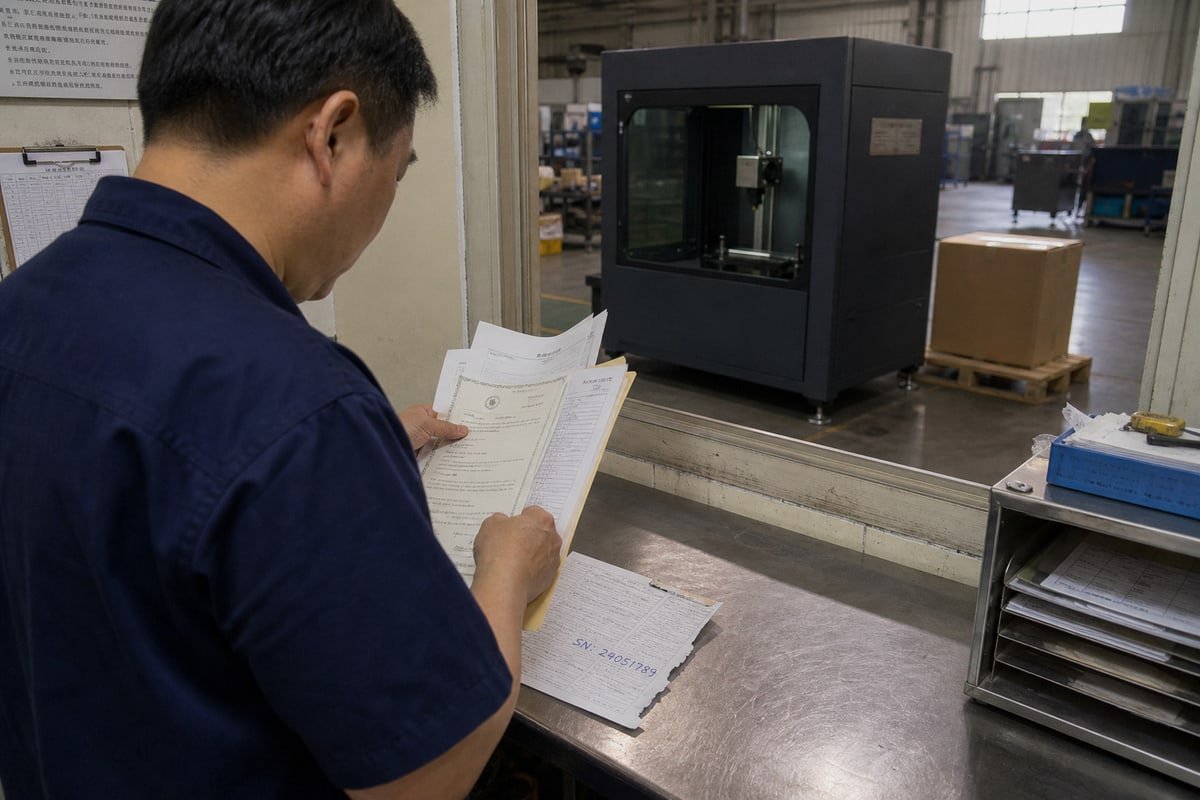
Documents are harder to fake consistently than marketing pages, because they must agree with each other. A real installation leaves a paper trail: an invoice, a shipping record, a certificate, and commissioning data that all reference the same machine, the same buyer, and the same dates. When I assemble a verification pack for a prospect, I check that internal consistency myself before sending it, because one mismatched serial number destroys trust instantly.
The Five-Document Verification Pack
| Document | What It Proves | How to Check It |
|---|---|---|
| Proforma invoice of the marked order | A real commercial transaction happened | Buyer name and country should match the case study; dates should align with the project timeline |
| EU Declaration of Conformity and CE certification | The specific machine model meets EU requirements | The certificate must name the exact model and serial number, not just the supplier's brand |
| Export shipping records to the EU | Physical proof of delivery to Europe | Bill of lading, destination port, and consignee should match the claimed customer's country |
| Commissioning and OQ/PQ data | The claimed accuracy was achieved in real production | Ask for raw Operational and Performance Qualification results, such as verified ±0.02 mm positioning accuracy |
| Real cooperation photos | The relationship exists beyond paper | Customer staff, plant environment, and machine serial should be visible and consistent |
Go Beyond Paper When the Order Is Large
For high-value orders, commission a factory audit through an independent body such as SGS or Intertek. This "proof of life" visit confirms that European-spec machines are actually in production and that the supplier operates under ISO 9001 standards 3 rather than assembling from a trading office. Some suppliers now also offer digital birth certificates or blockchain-based assembly logs that give a tamper-proof record of component origin and factory testing. Ask whether these exist; the answer itself tells you how seriously the supplier treats traceability.
How do I evaluate whether a supplier's case studies match my specific industry and material needs?
Speed versus precision is the trade-off our engineers weigh daily when configuring vision positioning systems. A case study on flat steel plates says nothing about curved medical parts.
Match case studies to your needs by comparing material type, laser source, CCD camera setup, cycle time, and integration details against your own production line. A relevant case study names your industry, your material, and measurable results like accuracy or defect reduction.
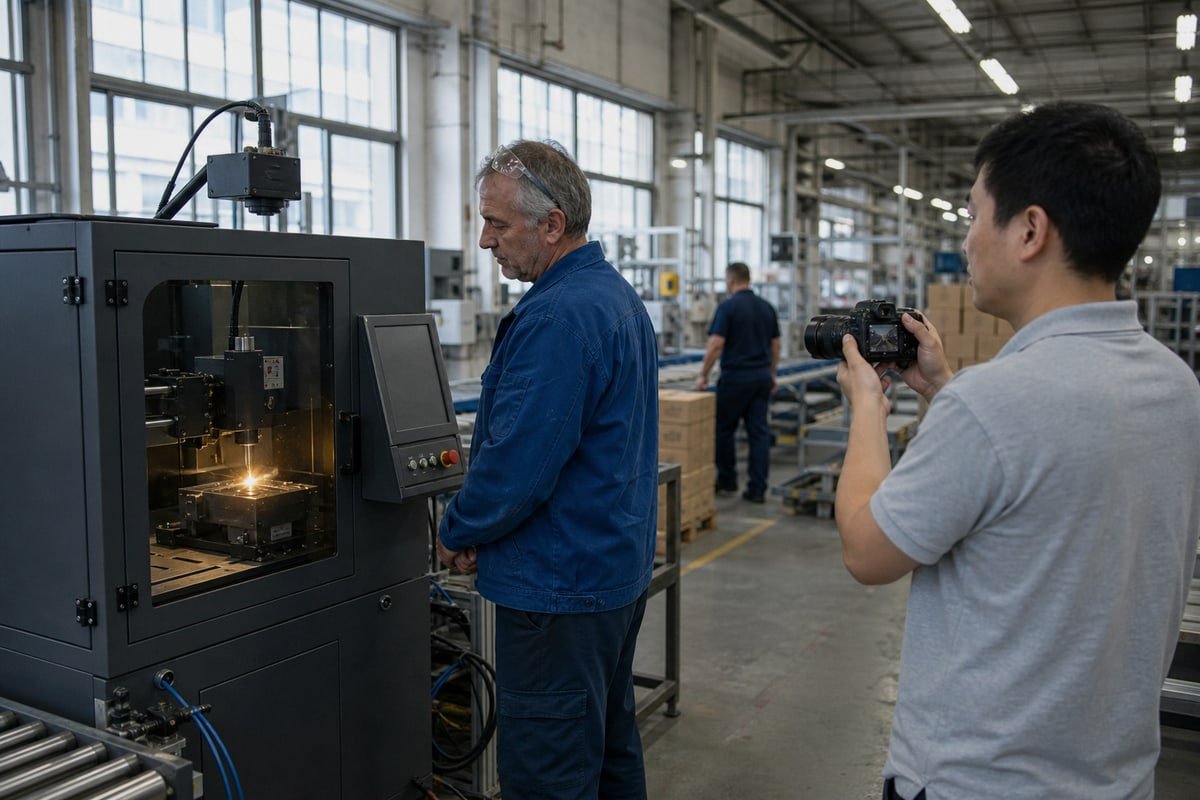
A genuine case study can still be the wrong case study for you. I have watched buyers get impressed by an automotive reference and then order a machine for PCB marking, which is a completely different application. Relevance requires matching on four technical layers, and each layer is something you can question the supplier about directly.
Layer One: Material and Laser Source
Fiber laser marking suits metals like stainless steel 4, aluminum, brass, and titanium alloy. Plastics such as ABS and PVC, and sensitive electronic components, often need different sources or parameters. If the case study material differs from yours, the results do not transfer. Beware the classic red flag phrase "works for all materials" — no single configuration does.
Layer Two: The Role of the CCD Camera
Ask exactly what the vision positioning system did in the referenced project: positioning, code reading, automated inspection, or automatic correction. Also ask about camera geometry, because it changes achievable precision.
| CCD Setup | How It Works | Best For |
|---|---|---|
| Coaxial (through-the-lens) | Camera views through the marking optics | Micro-marking for European medical and electronics sectors, highest precision |
| Off-axis | Camera mounted beside the laser head | Larger parts, general positioning, lower cost |
Layer Three: Integration and Automation Detail
Real industrial automation projects leave granular fingerprints. A credible case study mentions the PLC brand — Siemens or Beckhoff are common in Europe — the software version, the line communication protocol, and the cycle time achieved. Vague testimonials never contain these details; real engineering write-ups always do.
Layer Four: Pattern of Regional Traction
One installation could be a one-off shipment. Ask how many European installations exist, across which countries and sectors, and what the repeat customer rate is. Repeated success in your industry is the signal that matters.
Can I directly contact previous European customers to check their satisfaction with the CCD laser marking machine?
One lesson shaped our reference policy: hiding customers breeds doubt. Since we began arranging video calls between prospects and our European users, deals close faster.
Yes. Reputable suppliers arrange reference checks with prior European customers, subject to NDA limits. Ask for a call or plant visit, verify the contact's LinkedIn employment history, and question them about uptime, technical support response, integration, and whether they would buy again.

A direct conversation with a past buyer is the single strongest verification step available to you, because it is the one form of proof the supplier cannot script. Here is the process I recommend, based on how I set up these calls for our own prospects.
- Request the reference in writing. Ask for one European customer in your industry, or the closest match. A supplier who refuses every reference request, in every industry, is telling you something.
- Verify the person before the call. Check the contact's LinkedIn profile. Their role and employment dates should match the project timeline in the case study. A "plant engineer" who joined the company after the claimed installation is a red flag.
- Ask operational questions, not satisfaction questions. "Are you happy?" invites polite fluff. Instead ask: What was marked, on what material, and under what cycle time? How was commissioning handled? What is real machine uptime? How fast does technical support respond across the time zone gap? Would you buy the same machine again?
- Confirm the supplier's actual role. Some firms claim installations that a local integrator actually delivered. Ask the customer directly who commissioned the machine and who they call when something breaks.
Now, the honest nuance. Not every supplier can name customers publicly. NDAs and regulated-industry policies are real, especially in medical devices and aerospace. An anonymous case study with deep technical detail still carries value — just weight it lower than a named, contactable reference, and compensate with certificates, commissioning records, and a factory audit. Likewise, do not overvalue famous logos. A mid-sized Italian workshop that gives you a candid thirty-minute call is worth more than a household brand name you can never speak to.
Conclusion
Fake European case studies waste money. Demand the proforma invoice, on-site videos, machine-specific CE certificates, real cooperation photos, and EU shipping records. Genuine proof survives scrutiny — ours always does.
Footnotes
1. Official EU portal for verifying the validity of VAT numbers for companies registered in the European Union. ↩︎
2. Technical explanation of Programmable Logic Controllers used for the automation of industrial electromechanical processes. ↩︎
3. The international standard for quality management systems, ensuring products and services consistently meet customer requirements. ↩︎
4. Detailed overview of stainless steel grades and their widespread use in industrial and manufacturing applications. ↩︎