

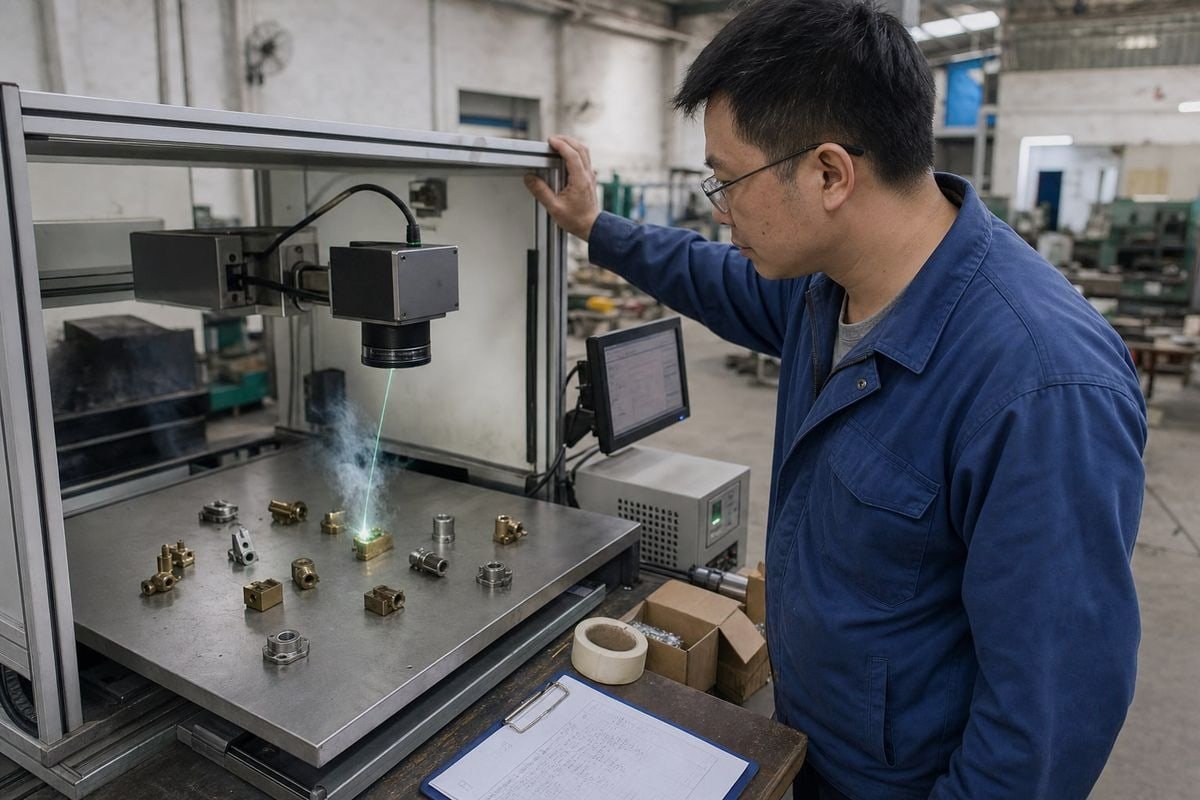
Small-batch shops keep asking us the same thing: is a CCD laser marking machine worth it for short runs CAD file formats 1? On our production line in Dongguan, we hear this question weekly. Jobs change fast. Fixtures pile up. Setup eats your margin. That pain is real, and it gets worse as your product mix grows.
Yes, a CCD laser marking machine suits small-batch production when jobs change often, parts are irregular, or fixturing is costly. Its visual positioning system cuts changeover time and removes jig-making, making it economical whenever setup time is a large share of total job time.
Let me break this down properly. Below, I will show you how to judge the fit, what the vision system 2 really saves you, whether the money makes sense, and how customization works.
How can I tell if a CCD laser marking machine fits my small-batch production needs?
Last year, a buyer from Italy sent me photos of his workbench: thirty different brass parts, each needing a different mark. His question was simple — will one machine handle all of this without thirty jigs?
A CCD laser marking machine fits your small-batch needs if you run many part types, switch jobs frequently, struggle with manual alignment, or spend more time positioning parts than marking them. Check template switching speed, CAD file support, and storage capacity before buying.

Here is the honest truth. Not every small-batch shop needs a vision system. The right question is not about volume. It is about mix and setup time. When I evaluate a customer's fit, I run through a five-point checklist that our engineers developed after years of installations.
My Five-Point Suitability Checklist
- Can the CCD vision quickly switch between different workpiece drawings? Test this yourself. Ask the supplier to demonstrate switching from one part template to another. If it takes clicks, not calibration, you are in good shape.
- How long does a product change take, and does it need parameter re-tuning? The best systems let you load a saved recipe and mark immediately. No re-focusing. No test pieces. This is where batch processing efficiency lives or dies.
- Does the machine support importing multiple CAD file formats? Small-batch work means files arrive from many customers in many formats — DXF, AI, PLT, and more. If the industrial vision software rejects half of them, you lose hours converting files.
- What is the device storage capacity? High-mix production means hundreds of stored templates. Check how many jobs the controller can hold locally.
- Is it stable under frequent order switching? Run a stress test. Switch jobs ten times in an hour and watch for software crashes or drift in marking accuracy.
Quick Fit Assessment Table
| Your Situation | CCD Fit? | Why |
|---|---|---|
| Many SKUs, short runs, irregular parts | Excellent | Vision removes fixture and alignment burden |
| Small parts placed by hand | Very good | Automated optical alignment corrects placement errors |
| One part, fixed position, long runs | Weak | Standard marker does the job cheaper |
| Traceability marks on mixed trays | Excellent | Camera identifies position and angle per piece |
If three or more checklist items matter to your workflow, the machine likely fits. If none do, save your money.
What advantages does CCD vision positioning offer when I switch between small production runs?
There is a trade-off I weigh with every customer: fixture cost versus camera cost. A physical jig is cheap once, but you need one per part. A camera is one investment that replaces all of them.
CCD vision positioning cuts changeover time from roughly 30 minutes to under 5 minutes in typical cases. It removes custom jigs, auto-corrects part rotation and displacement, allows random part placement, and lets operators switch product templates with one click between runs.
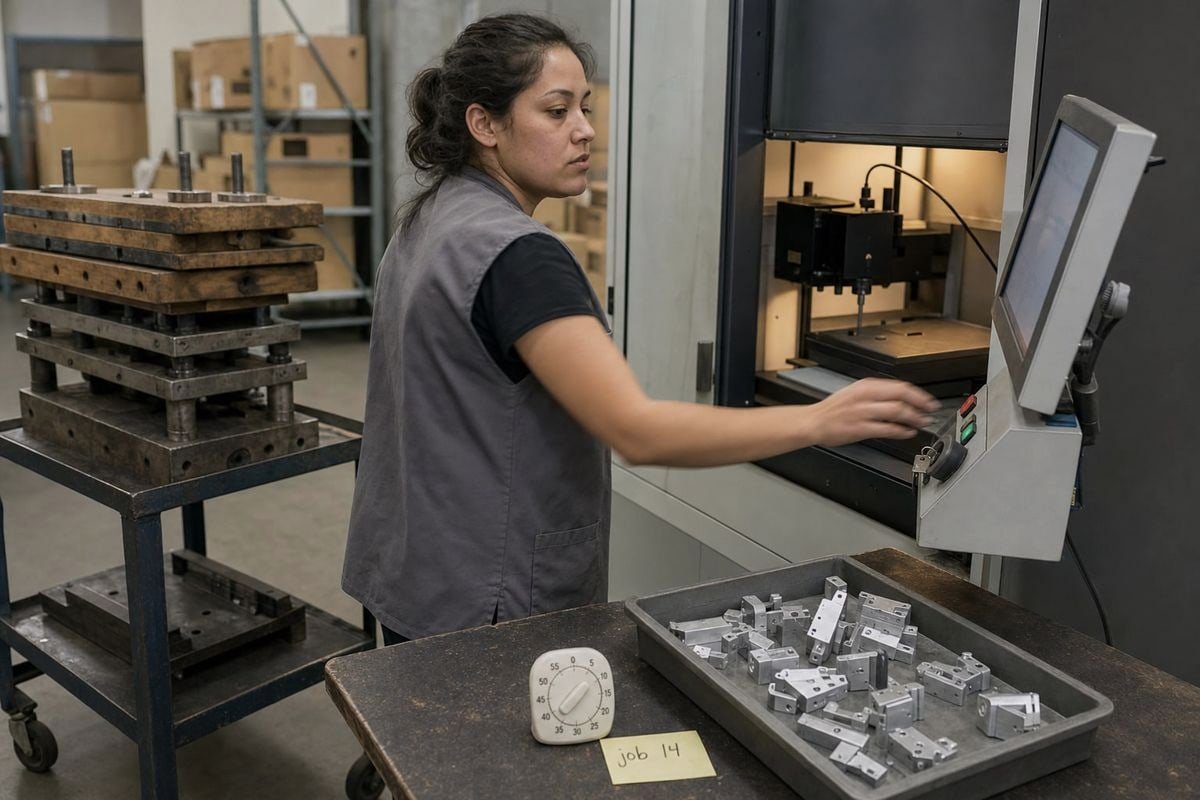
When we calibrate our vision systems before shipment, we simulate exactly this scenario: many small jobs, back to back, all day. The advantages show up in four distinct places.
Advantage 1: Jig-Less Operation
Traditional marking demands a fixture for every part shape. Design it. Machine it. Store it. Find it again next month. Jig-less laser marking skips all of that. The camera photographs the workbed, the software finds each part, and the laser adjusts the mark to match. Your operator simply places parts on a tray — even roughly — and presses start.
Advantage 2: Automatic Rotation and Offset Correction
Humans do not place parts perfectly. A visual positioning system 3 does not care. It detects each part's angle and position, then rotates and shifts the marking content to fit. This is why marking accuracy stays consistent even when placement is casual. Our engineers have found this matters most on tiny components, where a one-degree tilt ruins a mark by hand but is invisible to the camera workflow.
Advantage 3: One-Click Template Switching
Every product gets a saved template: mark content, laser parameters 4, and recognition model. Switching runs means loading a template, not re-teaching the machine. This is the single biggest driver of shorter production cycle time in high-mix shops.
Advantage 4: Multi-Part and Mixed-Tray Marking
Modern industrial vision software can find many parts on one tray and mark them in sequence. Some advanced systems even distinguish different part types on the same tray and apply the correct template to each.
| Task | Conventional Marker | CCD Laser Marking Machine |
|---|---|---|
| Part loading | Precise, fixture-guided | Random placement allowed |
| Changeover | Re-fixture, re-align, test mark | Load template, start |
| Typical changeover time | ~30 minutes | Often under 5 minutes |
| Fixture cost per new SKU | Recurring | Near zero |
| Operator skill needed | Higher | Lower after setup |
One caution from experience: recognition accuracy depends on lighting. Highly reflective or very dark materials may need adjusted lighting configurations. We test each customer's actual parts before shipping for exactly this reason.
Is the investment in a CCD laser marking machine worth it for my low-volume orders?
A purchasing manager from Sweden once told me his math: he did not care about the machine price. He cared about what each order cost him in setup hours. That reframing is exactly right.
The investment is worth it when setup and alignment consume a meaningful share of total job time. If you handle diverse low-volume orders, savings on fixtures, labor, and scrap typically deliver faster ROI than the extra vision hardware costs. For simple repeat jobs, it is overkill.
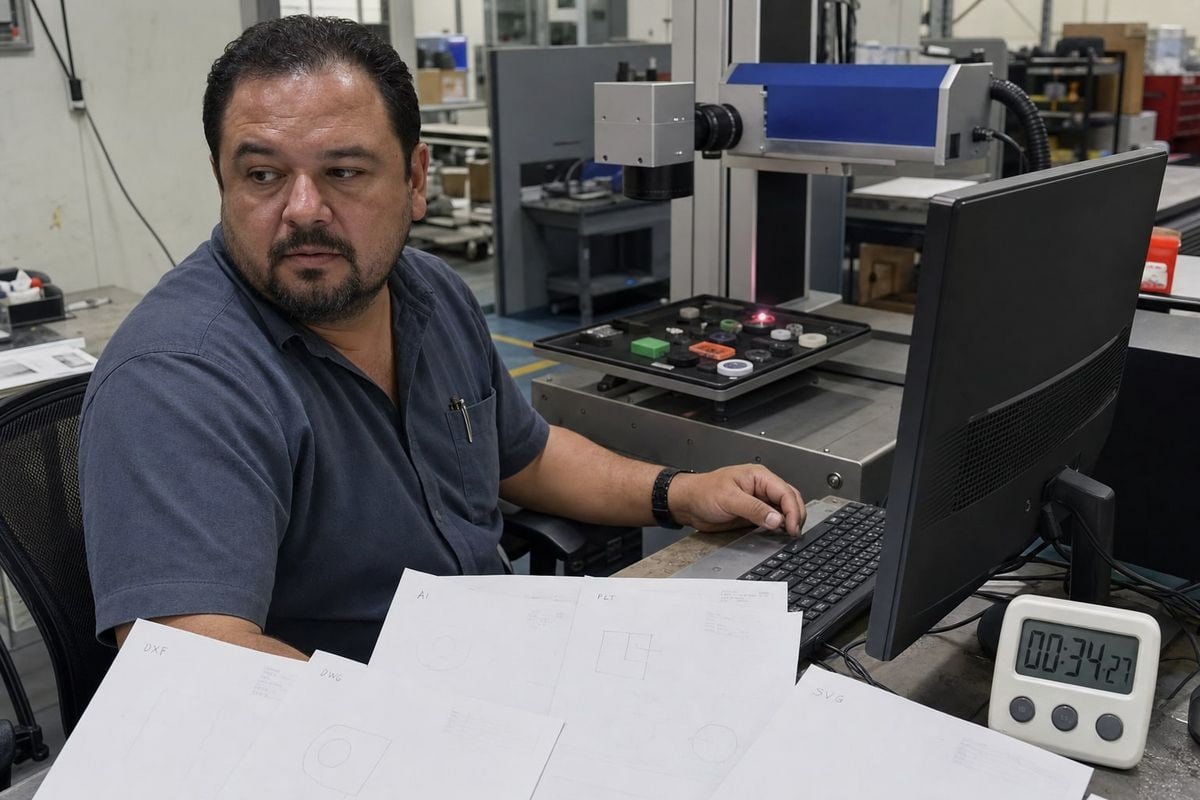
Let me be direct, because I would rather lose a sale than sell the wrong machine. The ROI question comes down to one ratio: setup time versus marking time.
Where the Money Actually Comes Back
The fiber laser source 5 itself marks at roughly the same speed with or without a camera. So the vision system does not make you faster at marking. It makes you faster at everything around marking. That includes:
- Fixture elimination. Every new SKU normally needs a jig. Design time, machining cost, storage space. With automated optical alignment, that recurring expense disappears.
- Labor reduction. One operator can load trays casually instead of positioning each piece precisely. Lower skill requirements also reduce training costs.
- Scrap reduction. A real-time software preview shows the mark on the actual workpiece image before firing. You catch misalignment before you waste a part. On expensive materials like titanium alloy 6 or medical device components, one saved part matters.
- Downtime reduction. Frequent product changes on a conventional machine mean frequent idle time. Fast template switching keeps the machine earning.
A Simple ROI Framing
| Factor | Favors CCD Investment | Favors Standard Marker |
|---|---|---|
| Order profile | Many SKUs, short runs | Few SKUs, long runs |
| Part geometry | Irregular, tiny, hard to fixture | Flat, simple, easy to fixture |
| Positioning tolerance | Tight, high-precision engraving needed | Loose, forgiving |
| Labor situation | Skilled operators scarce or costly | Cheap, available labor |
| Scrap cost per part | High-value materials | Low-value materials |
There is also a hidden-cost side. Vision systems need calibration, template creation, and operator training on the software. Budget a learning period. In our experience exporting to markets like the USA, Germany, and South Korea, customers who invest a few days in proper template setup recover that time within the first month of mixed production. Customers who skip training struggle and blame the machine.
The opposing view deserves airtime too. If your batch is tiny, the part is simple, and the mark location never moves, a standard marker with a basic fixture is the smarter buy. The camera would sit there adding cost without adding value.
Can I customize a CCD laser marking machine to handle my irregular or small-batch parts?
Early in my career at our Dongguan factory, we shipped a standard machine to a zipper maker. It came back frustrated feedback: the parts were too small and too oddly shaped for the default setup. That lesson shaped how our 20 solution engineers work today — customization first, standard configuration second.
Yes. CCD laser marking machines are highly customizable for irregular and small-batch parts. Suppliers can tailor the camera field of view, lens, lighting, recognition algorithms, feeding method, tray design, and software templates to match your specific part geometry, material, and workflow.

Customization is not one thing. It is a stack of decisions, and each one should follow from your actual parts. Here is how we approach it as a flexible manufacturing question, step by step.
The Customization Process We Follow
- Part analysis. You send sample parts or detailed drawings. We examine size, shape, material, surface finish, and the required mark. Reflective aluminum behaves differently from black ABS plastic under the camera.
- Optical configuration. We match the camera resolution and lens to your smallest feature. Ultra-small parts like screws, ICs, or capacitors need a tighter field of view. Larger irregular auto parts need a wider one, sometimes with a coaxial camera 7 for mark-and-verify workflows where the camera checks the mark right after firing.
- Lighting design. This is the step most buyers underestimate. Recognition accuracy on shiny brass or dark rubber depends heavily on light angle and type. We test your actual parts under different lighting before locking the design.
- Recognition template building. The software learns each part's outline or key features. For mixed trays, we build separate templates so the system distinguishes part types automatically.
- Feeding and handling. Options range from simple batch trays to conveyors with fly-marking, to vibratory feeders 8 for a true load-and-mark workflow. Small-batch shops usually start with trays and grow into automation.
- Software and connectivity. Modern systems can accept serial number sequences, database links, or remote design updates, which helps small businesses push jobs to the machine without walking to it.
The practical takeaway: bring your worst parts to the supplier, not your easiest ones. If the vision system handles your most irregular, most reflective, smallest component reliably in a live demo, everything else will be easy. We routinely run these validation tests on video call for overseas buyers before any order is confirmed, because seeing your own part marked correctly answers the question better than any brochure.
Conclusion
Small-batch production punishes slow changeovers. A CCD laser marking machine solves that when your jobs are mixed and irregular. Test switching speed, verify CAD support, and demand a live demo with your own parts.
Footnotes
1. Explains CAD file standards referenced for machine compatibility with design files. ↩︎
2. Comprehensive overview of machine vision technology and its industrial applications. ↩︎
3. Provides background on machine vision technology underlying CCD positioning systems. ↩︎
4. Scientific overview of laser physics and the parameters that govern beam performance. ↩︎
5. Technical explanation of fiber laser technology and its role in modern industrial marking. ↩︎
6. Gives material context for titanium alloy parts mentioned as high-value scrap risk. ↩︎
7. Connects coaxial camera use to broader laser marking and engraving technology context. ↩︎
8. Defines vibratory feeder mechanism used for automated part handling in production. ↩︎