

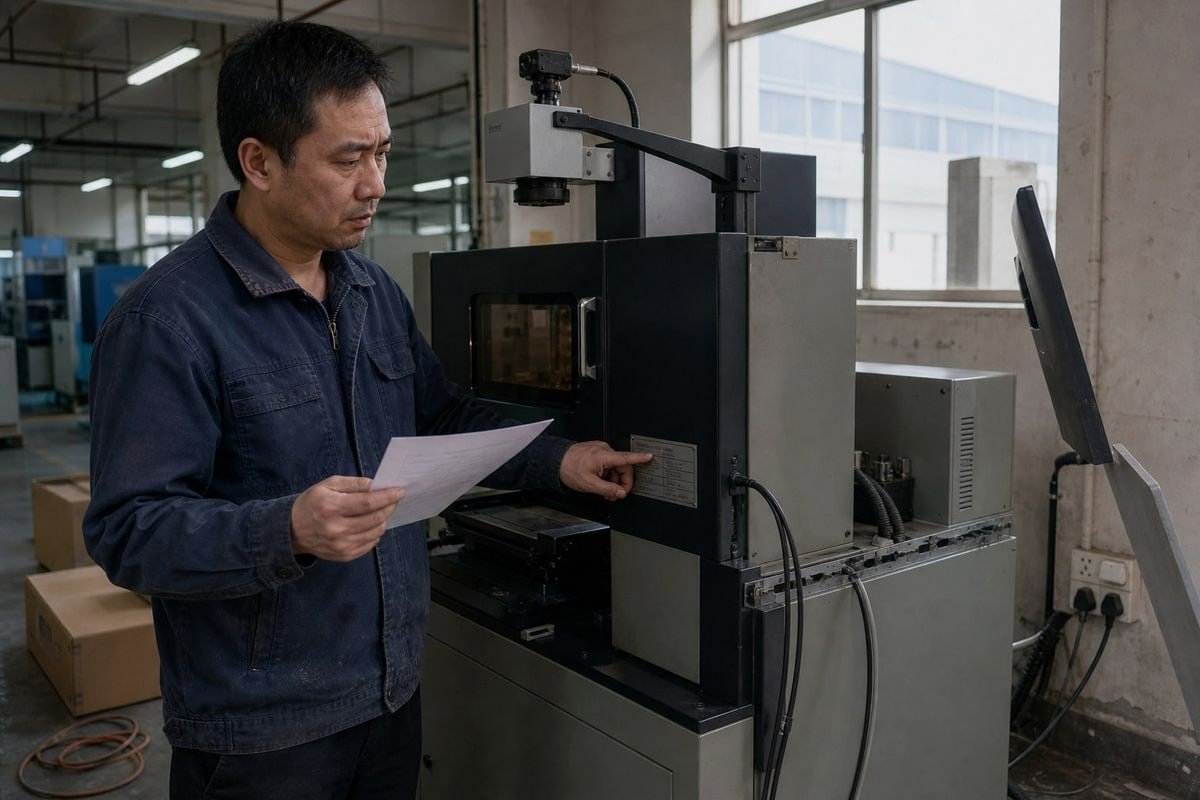
Buyers often ask me about a CCD laser marking machine 1‘s energy cost before anything else. On our Dongguan production line, that question comes up in almost every sales call.
A CCD laser marking machine’s energy cost is usually a small share of your operating budget, often $15–$200 per month. However, auxiliary loads, standby draw, and multi-shift production can multiply it, so calculate total wall-plug power, not just the laser’s rated wattage.
The problem is that many buyers only look at the laser’s nameplate wattage. That number hides cooling, vision, and idle loads. If you budget wrong, your total cost of ownership 2 drifts upward quietly. In this article, I will break the numbers down so you can budget with confidence.
How much electricity does a CCD laser marking machine actually consume per hour?
Last month, a buyer from Turkey sent me a photo of his electricity bill and asked if our machine caused the spike. It did not, and here is how we proved it.
A typical fiber-based CCD laser marking machine draws 500–1,500 watts at the wall while running. That equals roughly 0.5–1.5 kWh of electricity usage per hour, costing about $0.08–$0.23 per hour at a $0.15/kWh rate.
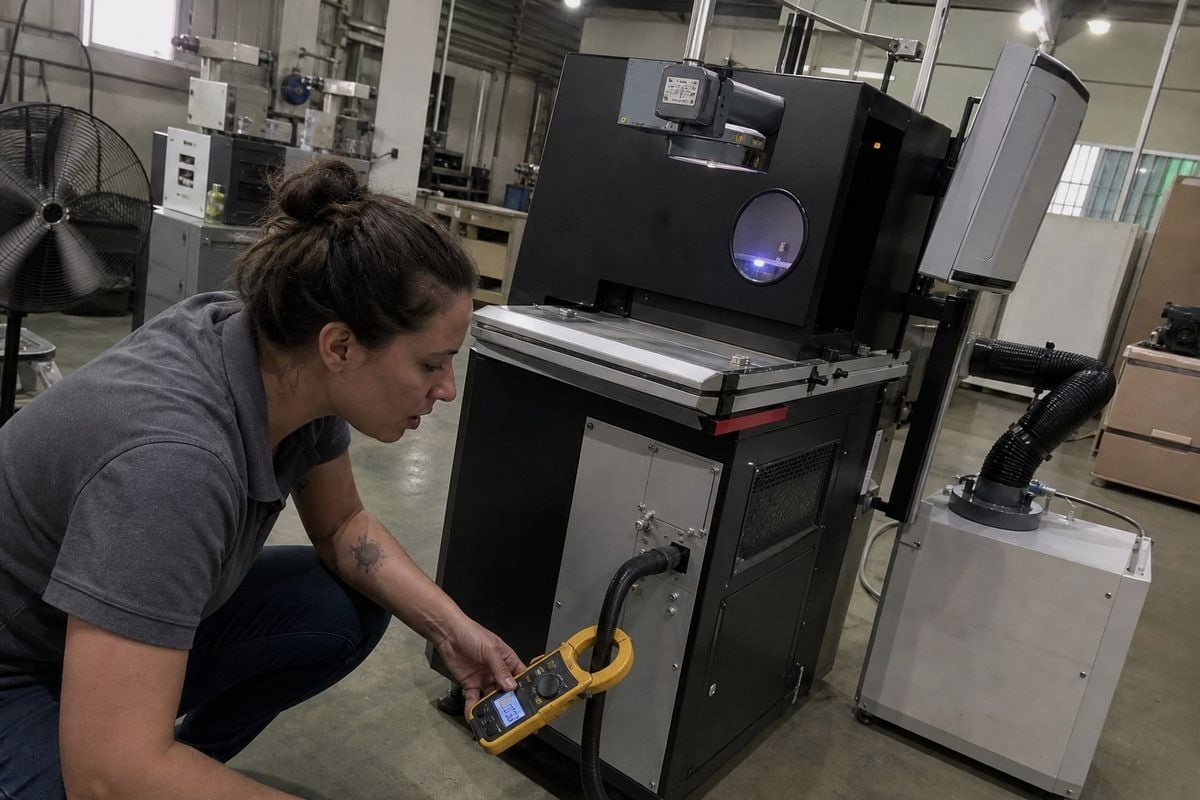
The first thing I tell every customer is simple: check the rated power of the whole machine, then work out the hourly electricity cost from that. Do not use the laser module's wattage alone. A 30W fiber laser does not consume 30 watts. In real operation, a 30W system draws roughly 500–800 watts once you add the controller, the galvo scanner, the CCD camera, illumination, and the industrial PC. A 20W unit typically pulls around 500 watts, which is 4 kWh over an eight-hour shift. A 100W fiber system can total 800–1,500 watts while working.
A quick hourly cost table
| System | Real wall-plug draw 3 | kWh per hour | Cost per hour ($0.15/kWh) |
|---|---|---|---|
| 20W fiber + CCD | ~500 W | 0.5 | ~$0.075 |
| 30W fiber + CCD | 500–800 W | 0.5–0.8 | $0.075–$0.12 |
| 100W fiber + CCD | 800–1,500 W | 0.8–1.5 | $0.12–$0.23 |
| Lamp-pumped YAG (older) | ~6,000 W | 6.0 | ~$0.90 |
Run the numbers for a full day. A 30W machine at eight hours and $0.15/kWh costs about $0.72 per day, or roughly $15.84 across 22 working days. That is lunch money, not a budget crisis. But scale changes everything. Three shifts triple the hours. A high electricity rate region doubles the unit price. Ten stations multiply the total by ten. So the same machine can cost $16 or $500 a month depending on how you run it. That is why fiber laser power consumption should always be calculated at the wall, per hour, for your actual shift pattern.
Can I calculate my long-term operating costs before buying a CCD laser marking machine?
Before we quote any project, our solution design engineers run a five-step cost worksheet with the buyer. I learned to insist on this after a Philippine client under-budgeted his second production line.
Yes. Multiply average wall-plug kilowatts by operating hours and your local electricity rate, then add maintenance, labor, and facility costs. Divide by annual output to get per-unit cost. Most fiber CCD systems land between $50 and $200 per month in electricity.

The core formula is one line: monthly cost = average kW × operating hours × electricity rate. But long-term budgeting needs more than one line. Here is the process I walk buyers through, and it mirrors how I evaluate machines on our own floor:
- Check the whole machine's rated power and calculate the hourly electricity cost at your local rate.
- Separate standby draw from production draw. A machine idling at 150–200 watts for four hours a day adds up silently.
- Compare the laser's electro-optical conversion efficiency. Fiber sources convert up to 30% of electrical input into laser output; older technologies waste far more as heat.
- Work out the energy cost per marked part. Take the hourly cost and divide it by your production throughput efficiency, meaning parts per hour.
- Combine per-unit cost with annual volume to estimate the total yearly energy spend.
Sample annual worksheet
| Line item | Small shop (1 shift) | Factory (3 shifts) |
|---|---|---|
| Average wall-plug draw | 0.8 kW | 1.2 kW |
| Hours per year | 2,000 | 6,000 |
| kWh per year | 1,600 | 7,200 |
| Cost at $0.15/kWh | $240 | $1,080 |
| Parts per year | 400,000 | 2,400,000 |
| Energy cost per part | $0.0006 | $0.00045 |
Notice the paradox in that last row. The three-shift factory pays more in total but less per part. Higher utilization improves your return on investment because fixed warm-up and idle losses are spread over more sellable units. Some buyers object that energy is negligible and not worth this math. For a single station, they are nearly right. But once you plan multiple stations, high rates, or 24/7 operation, this worksheet is what separates an accurate quote from a surprise. Running it before purchase costs you ten minutes and protects your total cost of ownership for years.
What factors influence the energy efficiency of a CCD laser marking system?
During a factory audit for a German customer, we metered every component on one of our workstations separately. The results surprised even our own engineers.
Energy efficiency depends mainly on laser source type and its electro-optical conversion rate, cooling method, standby management, and auxiliary loads like the vision system, PC, and exhaust. Fiber lasers at up to 30% wall-plug efficiency dominate CO2, semiconductor, and lamp-pumped YAG designs.
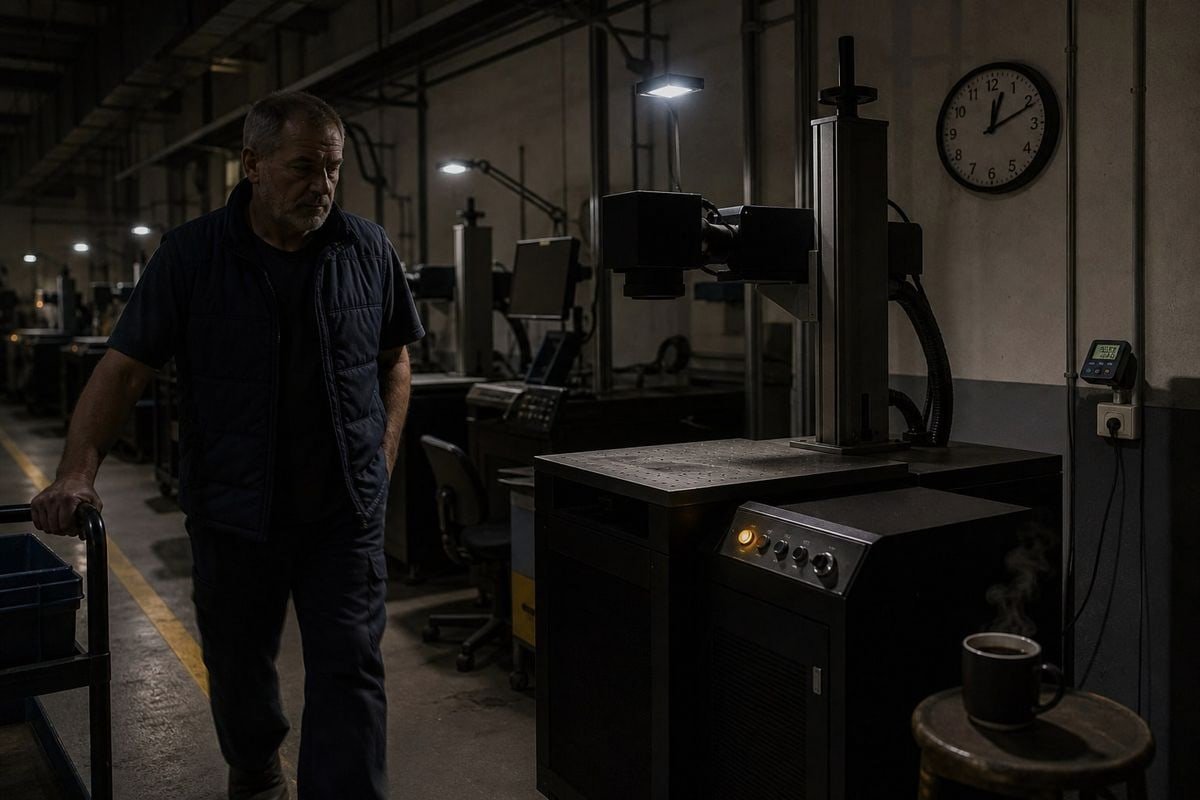
The laser source is the biggest lever. This is why I always tell buyers to compare electro-optical conversion efficiency between quotes, not just price. Fiber sources convert up to 30% of electrical input into usable laser power. Semiconductor systems draw 1.5–2 kW for similar work. Old lamp-pumped YAG machines can pull around 6 kW, which is ten times the roughly 600 W average of a fiber marking station. That gap alone can decide your operating budget for a decade, because laser source longevity means you will live with this choice for 50,000 to 100,000 hours.
The cooling question
Cooling system power draw is the most volatile variable in the whole budget. Air-cooled fiber systems need only fans. Water chillers on higher-power or UV systems can consume more electricity than the laser source itself, and their duty cycle changes with ambient temperature. If your workshop sits in a hot climate like the UAE or Saudi Arabia, budget the chiller separately.
Hidden and emerging loads
| Component | Typical draw | Budget impact |
|---|---|---|
| CCD camera + illumination | 20–60 W | Small, constant |
| Industrial PC + controller | 100–250 W | Moderate, runs even at idle |
| Exhaust / fume extraction | 100–500 W | Often forgotten |
| Water chiller (if fitted) | 300–1,500 W | Can exceed the laser itself |
| Air assist compressor | 200–750 W | Duty-cycle dependent |
Newer designs also shrink these numbers. GaN power supplies inside the controller cut cabinet heat, which lowers both direct loss and internal fan load. Edge-AI processing inside the CCD camera module offloads work from the main PC, saving incremental power in 24/7 operation. Dynamic pulse shaping software can trim power draw by up to 12% on complex marks by optimizing the duty cycle for each material. Soft-start sequencing avoids high-amperage spikes that trigger utility demand surcharges. None of these features is dramatic alone, but together they define industrial automation overhead across a fleet.
How can I reduce my energy costs without sacrificing marking precision?
A client in Italy once asked me, half joking, whether he should just switch the machine off between batches. My answer was more nuanced than he expected, and it saved him real money.
Reduce energy costs by choosing a high-efficiency fiber source, managing standby time, batching jobs to raise throughput, using CCD alignment to eliminate scrap, and optimizing pulse parameters per material. Precision improves rather than suffers, because every watt goes into sellable output.
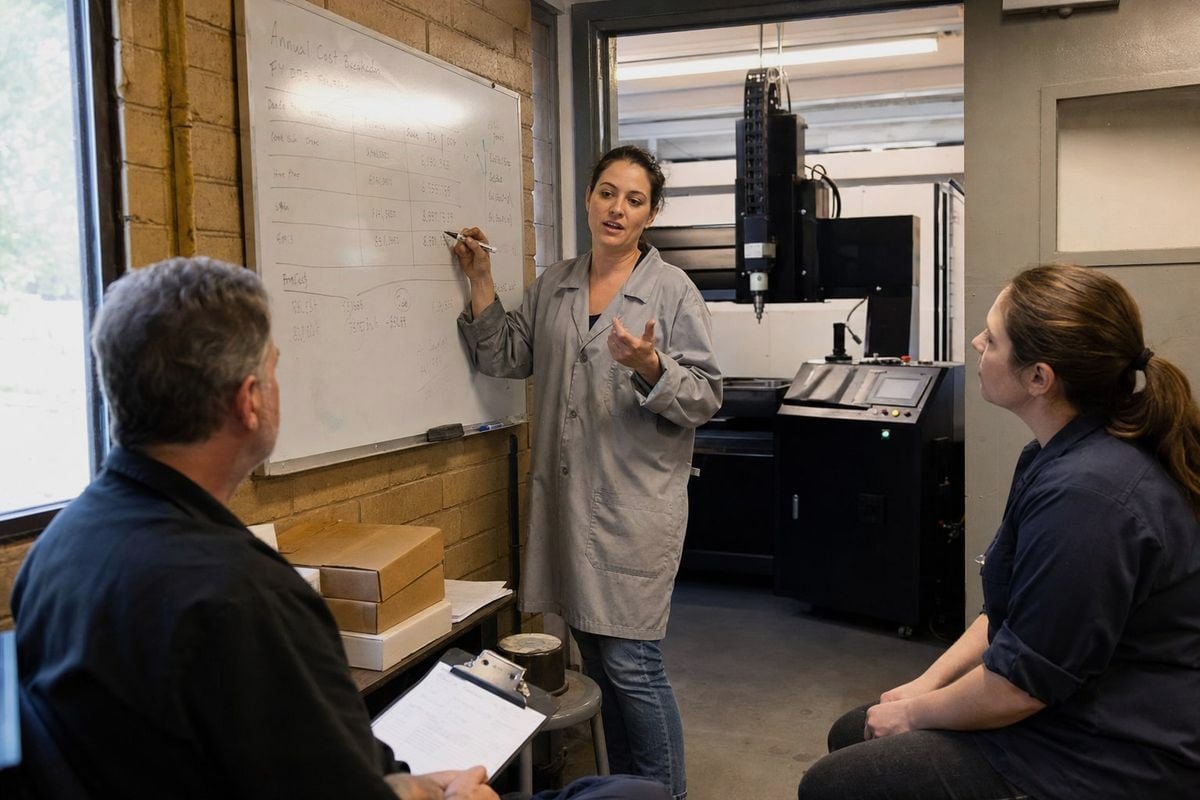
The best energy-saving strategy is counterintuitive: spend energy well instead of spending less of it. This is exactly where the vision positioning system earns its keep. A CCD camera adds perhaps 40 watts of draw. But it prevents misaligned marks on expensive substrates. One scrapped PCB or medical device housing wastes the material, the labor, and every watt already invested in it. In our experience supplying automated lines across Southeast Asia and Europe, automated quality control through CCD alignment saves far more money in scrap than it ever adds in electricity. That is scrap energy, and eliminating it is the single largest efficiency gain available.
Practical steps, ranked by impact
- Cut standby waste. Meter your idle draw. If the machine sits powered but unproductive for hours daily, schedule shutdowns or use sleep modes. Distinguish standby consumption from production consumption in your logs, because they behave differently.
- Batch your jobs. High-speed throughput with automated visual positioning 4 maximizes parts processed during each active power cycle. Warm-up energy is fixed; more parts per cycle means lower per-unit cost.
- Tune pulse parameters. Dynamic pulse shaping matched to your material avoids dumping excess thermal energy into the part. This protects delicate plastics and anodized aluminum while trimming draw.
- Right-size your cooling. Do not run a chiller sized for 100W on a 30W station. Air cooling suffices for most fiber marking work.
- Retire consumable-heavy processes. Replacing ink systems with drying ovens, or mechanical marking with high-pressure compressors, removes entire energy-hungry subsystems from your line.
One objection I hear often: does a cheaper, less efficient machine still win on total cost? Usually not. Lower upfront price often pairs with worse conversion efficiency, slower cycles, and higher maintenance. Over five years, throughput and efficiency dominate the purchase price difference. Precision and energy savings are not in conflict. They come from the same engineering discipline.
Conclusion
Energy cost rarely dominates a CCD laser marking machine budget, but ignoring wall-plug draw, standby losses, and auxiliary loads invites surprises. Calculate real consumption per part, and budget with confidence.
Footnotes
1. Comprehensive overview of laser marking and engraving technology, including machine types and industrial applications. ↩︎
2. Government resource for calculating industrial energy efficiency and long-term total cost of ownership. ↩︎
3. Leading technical organization for electrical engineering standards regarding power consumption and wall-plug efficiency. ↩︎
4. Authoritative source for international standards in industrial automation and machine vision positioning systems. ↩︎