
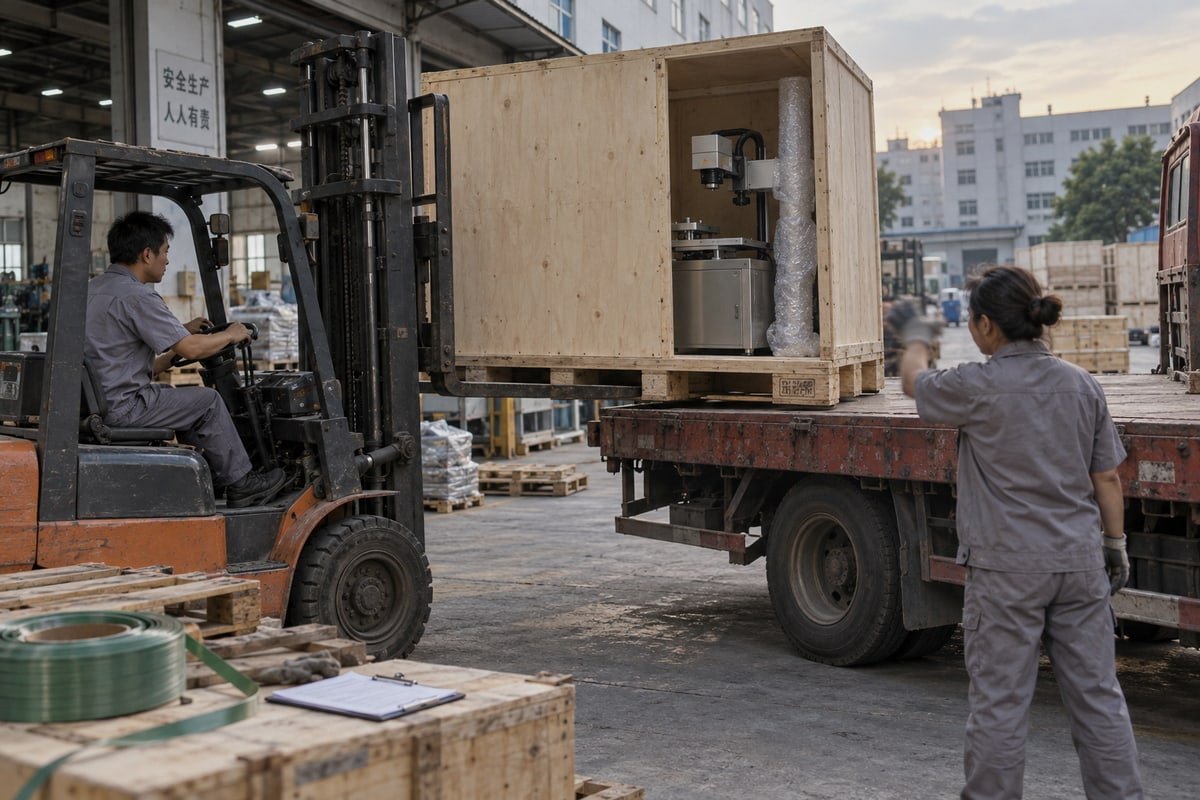
Your CCD laser marking machine packaging can clear customs in hours or sit at port for weeks. The crate decides, not the machine. Our Dongguan team learned this early.
CCD laser marking machine packaging meets ISPM 15 only when every solid wood component—crate, skids, blocking, dunnage—is treated by an approved facility and carries a valid IPPC mark with country code, provider code, and treatment code. The machine itself is not regulated; plywood-only packaging is exempt.
That answer sounds simple. In practice, the details decide everything. Below, I walk through how we verify the wood, what paperwork to ask for, what goes wrong at the border, and how to read the stamp on a Lansulaser crate yourself.
How Do I Verify My CCD Laser Marking Machine's Wood Packaging Is ISPM 15 Certified?
A purchasing manager in Italy once asked me to prove the crate, not the machine, was certified. That question is the right one. Here is how we answer it.
Verify ISPM 15 compliance by inspecting every solid wood part of the crate for a permanent IPPC certification mark showing the IPPC symbol, two-letter country code, treatment provider number, and treatment code such as HT. Plywood walls are exempt, but untreated runners, blocks, or dunnage fail the standard.
The first thing I tell every buyer is this: ISPM 15 regulates wood packaging, not equipment. Your CCD laser marking machine does not need a stamp. The box it travels in does. So verification starts with a material-by-material review of the crate, not with the product manual.
Which parts of the crate are regulated?
Our standard export crate uses export grade plywood 1 for the walls and lid. Plywood is a processed wood product. The glue and heat used in its manufacture remove the pest risk, so it sits outside ISPM 15. The same applies to oriented strand board, particle board, fiberboard, veneer panels, and any wood made entirely from pieces 6 mm thick or less.
The problem is the base. A laser marking system with a cabinet, a CCD visual positioning system, and a lift column is heavy. We put it on solid wood skids 2 and secure it with timber blocking. That is solid wood packaging material. Every one of those pieces must be treated and marked.
| Crate component | Typical material | ISPM 15 status |
|---|---|---|
| Outer walls and lid | Export grade plywood | Exempt |
| Base skids and runners | Solid sawn timber | Regulated — must be treated and marked |
| Corner blocks and cleats | Solid sawn timber | Regulated |
| Internal blocking and wedges | Solid sawn timber | Regulated |
| Foam, film, desiccant | Non-wood | Not applicable |
| Loose dunnage in the container | Solid timber | Regulated |
The hybrid crate trap
Here is where many shipments fail. A buyer sees a plywood box, assumes the whole thing is exempt, and never looks underneath. Then an inspector finds untreated runners. The exemption only applies to the whole component. A plywood panel nailed to an untreated pine frame is still a regulated crate.
So my first personal rule is simple: check the IPPC mark 3 on the solid wood, not on the label. Then confirm the mark includes a recognized treatment code. We use HT, which means heat treated wooden crates 4 where the wood core reached at least 56°C for at least 30 continuous minutes. That temperature must reach the center of the thickest skid, not just the surface.
If a component has no mark and is clearly solid timber, treat the shipment as non-compliant until your supplier proves otherwise.
What Documents Should I Request to Confirm My Supplier's Fumigation Compliance?
We weigh two things with every export: how much paper to send and how much the paper actually proves. Documents help. They never replace the stamp on the wood.
Request a heat treatment certificate from the authorized packaging facility, the supplier's wood packaging declaration listing every solid wood component, the treatment provider's registration number, clear photographs of the IPPC mark on at least two sides, and confirmation that your destination country accepts the treatment code used.

When I started handling exports to Germany, the UK, and the USA, I thought a one-page certificate would settle every question. It does not. Different officers look for different things. So we now build a small document pack for every shipment, and I recommend buyers ask for the same.
The document pack we send
- Treatment certificate from the packaging facility. This names the facility, its official registration code, the treatment method, and the batch of wood. It should show the facility is authorized by the national plant protection organization in China. This matches my own rule: verify the packaging supplier’s qualifications, not just the stamp.
- Wood packaging declaration. A short list of every solid wood component in the crate. Skids, blocks, braces, wedges, dunnage. If it is timber, it is on the list.
- Photographs of the IPPC mark. Taken before film and strapping go on, from two opposite sides, close enough to read every character.
- Packing list and commercial invoice. These must match the crate dimensions and weight. Mismatches invite closer inspection.
- Destination-country confirmation. We check whether the importing country accepts HT, and we note it in the file.
| Document | What it proves | What it does not prove |
|---|---|---|
| Treatment certificate | Wood batch was treated by an authorized facility | That every piece in your crate came from that batch |
| Wood packaging declaration | Supplier identified all solid timber | That each piece carries a valid mark |
| Mark photographs | Mark existed and was legible at dispatch | That the mark survived transport |
| Phytosanitary certificate | Plant products meet import health rules | ISPM 15 status of wood packaging |
Why a phytosanitary certificate is not enough
Buyers often ask for a phytosanitary certificate. That document is issued for regulated plant products. It is not the ISPM 15 control for packaging. The physical IPPC mark is the control inspectors recognize. A supplier who offers only paperwork, or a vague "fumigated" line on an invoice, has not shown compliance.
One more point. Some buyers push back and say, "Just give me the certificate and I will stop asking about the stamp." I understand the wish to save time. But I resolve this the same way every time: the certificate supports the mark. It never replaces it. If the stamp is missing, no certificate will save the shipment.
Will Non-Compliant Packaging Cause Customs Delays for My Laser Marking Machine Shipment?
The lesson that stuck with our logistics team: customs officers inspect wood, not intentions. A single untreated wedge under a chassis can hold an entire container.
Yes. Non-compliant wood packaging commonly triggers inspection holds, mandatory re-treatment, crate replacement, destruction, or re-export of the whole shipment at the importer's cost. Missing or illegible IPPC marks, untreated dunnage, residual bark, and unaccepted treatment methods are the most frequent causes of delay.

Delivery delay is one of the top three worries I hear from business owners. Most of them picture a slow factory. Few picture a crate sitting in a quarantine yard. Yet packaging is the delay I can prevent most easily, so I want to be clear about what triggers it.
Common failure points and how we avoid them
| Border problem | Why it happens | How we prevent it |
|---|---|---|
| Missing IPPC mark | Untreated timber used for base or blocking | All solid wood sourced from an authorized treatment facility |
| Illegible mark | Weak stamp, rough wood, or stamp under film | Mark checked and photographed before wrapping |
| Residual bark | Timber not debarked before treatment | Debarked wood requirements confirmed at purchase |
| Untreated dunnage | Loose timber added at container loading | Only marked dunnage allowed in the container |
| Post-treatment cutting | Skids trimmed on site, exposing raw wood | Crates built to size; no cutting after marking |
| Unaccepted method | Destination rejects the treatment code | Destination rules checked before dispatch |
Why we chose heat treatment over methyl bromide
Methyl bromide 5 treatment is still a recognized method under ISPM 15, with the MB code. We do not use it. Two reasons. First, wood pieces over 20 cm in cross-section cannot be treated with methyl bromide under the standard, and heavy machinery skids sometimes approach that size. Second, several of our export markets restrict the chemical. Heat treatment avoids chemical residue and is accepted almost everywhere we ship, from Sweden to Saudi Arabia.
The solid timber versus engineered wood objection
Some buyers argue we should drop solid timber entirely and use plywood or metal frames. That would remove most ISPM 15 questions. I weigh this often. The trade-off is strength. Engineered panels can swell in humid ocean transit and may not carry a heavy cabinet safely through forklift handling. Metal frames cost more and need custom design. So we keep a hybrid: plywood walls, heat-treated solid wood base. We minimize raw timber, and we treat and mark every piece that remains.
International shipping regulations do not reward good intentions. Customs clearance compliance comes down to what the inspector sees on the wood that day.
How Can I Check the ISPM 15 Stamp on My Lansulaser Equipment Crate Before Export?
Before each Lansulaser crate leaves Dongguan, one of our QC staff photographs the stamp from both sides. One blurry stamp taught us why that photo matters.
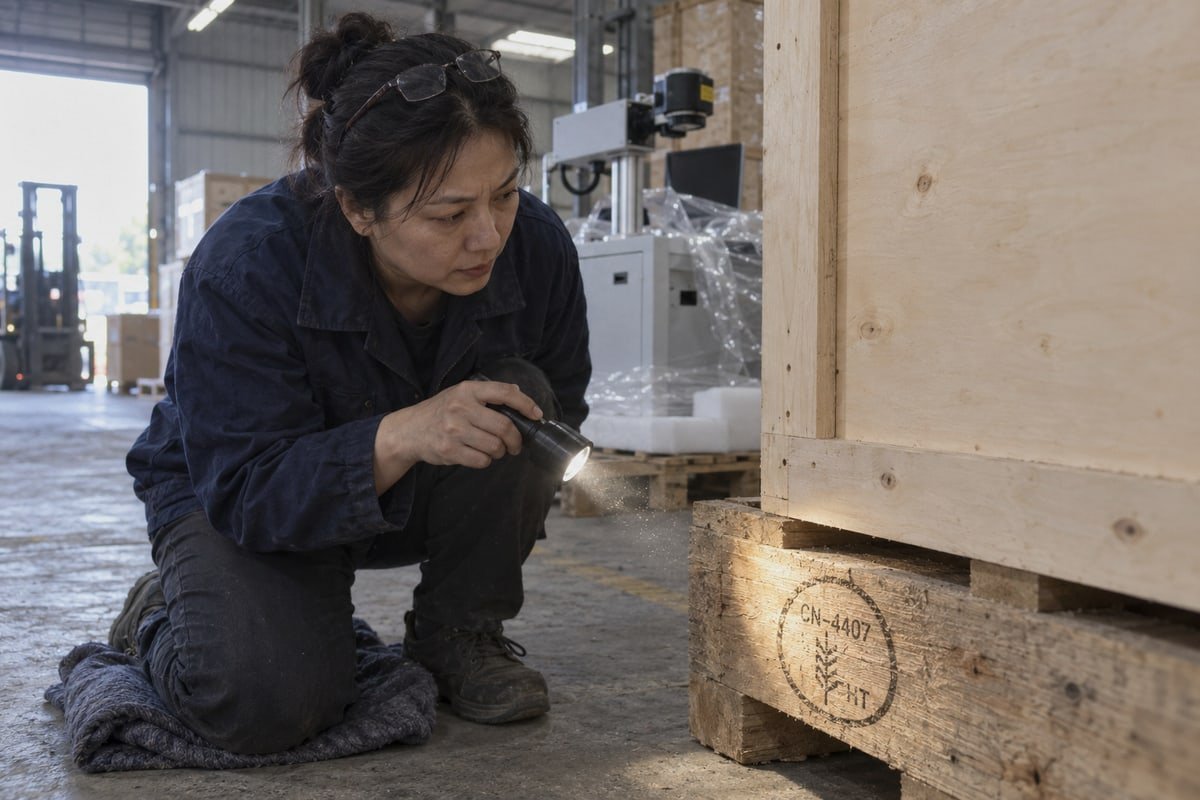
Check the ISPM 15 stamp on a Lansulaser crate by locating the bordered IPPC mark on two opposite sides, confirming it shows the IPPC symbol, CN country code, the treatment provider's code, and HT, and verifying it is complete, legible, permanent, and not hidden under straps or film.

This is the check I ask our own team to run, and it is the same check I ask buyers to run on arrival. It takes a few minutes. It is based on five rules I apply to every crate.
The five-step stamp check
- Confirm the IPPC mark exists. Look for the bordered rectangle with the wheat-ear IPPC symbol. A plain "heat treated" stencil is not the mark. A supplier logo is not the mark.
- Read the treatment code. On our crates it should say HT. If you see MB, DH, or SF, check that your destination accepts it before the crate ships.
- Ask for the treatment proof. Match the provider code in the stamp to the code on the treatment certificate. They must agree.
- Judge the clarity. Every character should be complete and readable. The mark must be permanent. If it smudges under a thumb, it will not survive a port.
- Verify the packaging facility is authorized. The provider code should belong to a facility registered with the national plant protection organization.
| Mark element | What you should see | Red flag |
|---|---|---|
| IPPC symbol | Stylized wheat ear inside the border | Missing symbol or text-only stamp |
| Country code | Two letters, CN for crates treated in China | Country code does not match the treatment certificate |
| Provider code | Unique number for the treatment facility | Code not found in the certificate or registry |
| Treatment code | HT on Lansulaser crates | Blank, unclear, or non-standard code |
| Placement | Two opposite sides, on solid wood | Only on plywood, or covered by straps |
A note on how the mark is applied
Laser marking is an accepted way to apply the IPPC mark, because it burns a permanent, high-contrast mark that resists moisture and abrasion better than ink. We know this well, since marking onto uneven surfaces is what our CCD visual positioning system does every day on metal and plastic parts. But I want to be precise here. A laser only applies the mark. It does not treat the wood. The timber must be heat treated by a certified facility first. A clean laser stamp on untreated pine is still a non-compliant crate.
Finally, if you cut or trim a skid after the mark is applied, you expose untreated interior wood. Do not modify the crate before export. If you must, ask us for replacement treated timber and new marks.
Conclusion
A held crate costs you weeks and trust. The fix is simple: treated timber, a clear IPPC mark, and matching documents. That is how we ship every machine.
Footnotes
1. Technical overview of plywood manufacturing and its classification as a processed wood product exempt from ISPM 15. ↩︎
2. Official US Customs and Border Protection guidance on wood packaging material (WPM) and ISPM 15 compliance. ↩︎
3. Official homepage of the International Plant Protection Convention, the governing body for ISPM 15 standards. ↩︎
4. Official site for the American Lumber Standard Committee, which oversees heat treatment (HT) quality control standards. ↩︎
5. EPA regulatory information regarding methyl bromide, a chemical treatment option for wood packaging under ISPM 15. ↩︎